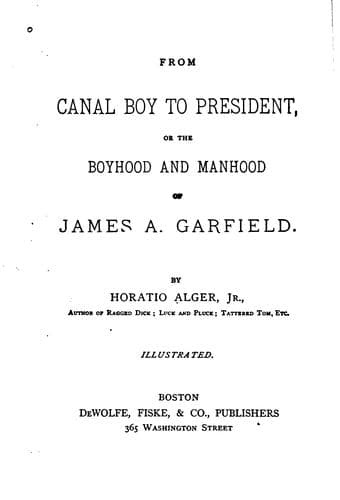
From Canal Boy to President; Or, the Boyhood and Manhood of James A. GarfieldAlger, Horatio, Jr.
History
From Canal Boy to President; Or, the Boyhood and Manhood of James A. Garfield
Alger, Horatio, Jr.
Garfield, James A. (James Abram), 1831-1881 -- Childhood and youth; Presidents -- United States -- Biography
Under date of June 18, 1877, Garfield writes "You know that my life has
abounded in crises and difficult situations. This trip has been,
perhaps, not a crisis, but certainly has placed me in a position of
extreme difficulty. Two or three months ago, W.B. Duncan, a prominent
business man in New York, retained me as his lawyer in a suit to be
heard in the United States Court in Mobile, and sent me the papers in
the case. I studied them, and found that they involved an important and
somewhat difficult question of law, and I made myself sufficiently
familiar with it, so that when Duncan telegraphed me to be in Mobile on
the first Monday in June, I went with a pretty comfortable sense of my
readiness to meet anybody who should be employed on the other side. But
when I reached Mobile, I found there were two other suits connected,
with this, and involving the ownership, sale, and complicated rights of
several parties to the Mobile and Ohio Railroad.
"After two days' skirmishing, the court ordered the three suits to be
consolidated. The question I had prepared myself on passed wholly out of
sight, and the whole entanglement of an insolvent railroad, twenty-five
years old, and lying across four States, and costing $20,000,000, came
upon us at once. There were seven lawyers in the case besides me. On one
side were John A. Campbell, of New Orleans, late member of the Supreme
Bench of the United States; a leading New York and a Mobile lawyer.
Against us were Judge Hoadley, of Cincinnati, and several Southern men.
I was assigned the duty of summing up the case for our side, and
answering the final argument of the opposition. I have never felt myself
in such danger of failure before, all had so much better knowledge of
the facts than I, and all had more experience with that class of
litigation? but I am very sure no one of them did so much hard work, in
the five nights and six days of the trial, as I did. I am glad to tell
you that I have received a dispatch from Mobile, that the court adopted
my view of the case, and gave us a verdict on all points."
Who can doubt, after reading of these two cases, that had Garfield
devoted himself to the practice of the law exclusively, he would have
made one of the most successful members of the profession in the
country, perhaps risen to the highest rank? As it was, he was only able
to devote the time he could spare from his legislative labors.
These increased as years sped. On the retirement of James G. Blaine from
the lower House of Congress, the leadership of his party devolved upon
Garfield. It was a post of honor, but it imposed upon him a vast amount
of labor. He must qualify himself to speak, not superficially, but from
adequate knowledge upon all points of legislation, and to defend the
party with which he was allied from all attacks of political opponents.
Public-domain text, read in full here on John Shaqi.
Reviews
Reviews
No reviews yet
Be the first to share your thoughts on this work.
Elsewhere in the archive
Join the Discussion
Join the discussion
Sign in to leave a comment or review.
Sign InorCreate an account