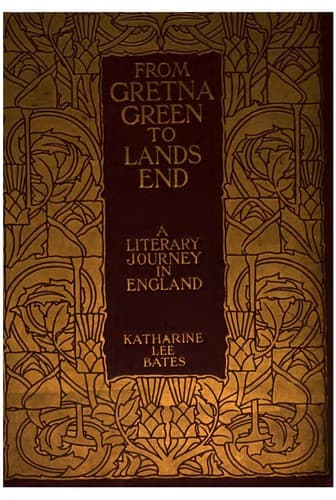
From Gretna Green to Land's End: A Literary Journey in England.Bates, Katharine Lee
General
From Gretna Green to Land's End: A Literary Journey in England.
Bates, Katharine Lee
England -- Description and travel
Far more delightful than automobiling were the leisurely drives we
took in the neighbourhood of Shrewsbury. One fair afternoon we drove
five miles southeast to Wroxeter to view the tragic ruins of the Roman
city of Uriconium. Here, at the junction of Watling Street with the
western Roman road, guarding these communications and the passes of
the Severn, stood "The White Town in the Woodland." After the Roman
armies were withdrawn, it was stormed and burned by the Saxons. The
lapse of fourteen hundred years has not obliterated the traces of that
anguish. Only a little below the surface lies earth still black from
the heats of the tremendous conflagration; charred bones crackle
beneath the tread; in an under-chamber of one of the baths has been
found the skeleton of an old man crouched between the pillars, as if
seeking refuge from the rage of fire and sword. The skeletons of two
women were beside him and, close to his bony hand, his little hoard of
coins. There still stands a rugged mass of wall some seventy feet in
length, its Roman string-courses of flat red bricks showing bright
against the prevailing grey of that jagged, gaping structure. Now
birds nest in it, and from the lower heaps and ranges of broken
masonry all about springs the wild rose as well as the thistle.
Uriconium was larger than Pompeii, and its ruins, said to be the most
extensive of their kind in England, smite one with heartache. We
roamed about its grassy hollows and thicketed mounds, its bone-strewn
forum, and its baths with their patches of mosaic flooring, their
groups of little brick columns, and other fragments of a perished
luxury. We wondered that the sky above this city left so desolate, a
sky of softest azure flecked with cloudlets dazzling white, did not
wear perpetual shadow for its sake. But those heavens were as serene
as if the dying wail of Uriconium had never pierced them, and the
cleft summit of Milton's "blue-topped Wrekin"--a deep, intense,
gleaming blue it was that afternoon--kept no memory of the day when
the Severn ran red with blood and its own head was veiled with smoke
and ashes.
Public-domain text, read in full here on John Shaqi.
Reviews
Reviews
No reviews yet
Be the first to share your thoughts on this work.
Elsewhere in the archive
Join the Discussion
Join the discussion
Sign in to leave a comment or review.
Sign InorCreate an account