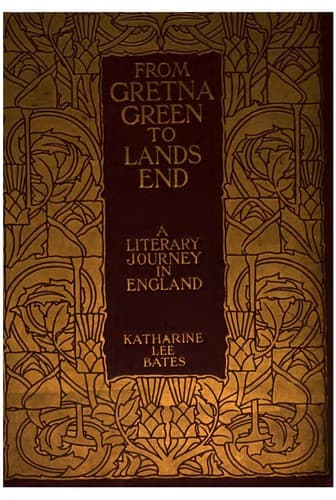
From Gretna Green to Land's End: A Literary Journey in England.Bates, Katharine Lee
General
From Gretna Green to Land's End: A Literary Journey in England.
Bates, Katharine Lee
England -- Description and travel
Yet even the little round county of Herefordshire, with its soft green
levels, its apple orchards and cider-presses, its hop gardens, and
those broad fields where graze its famous sheep and cattle, has tragic
tales to tell. Wigmore Castle, indeed, is over the Hereford line. A
few miles to the northwest are the ruins of Brampton-Bryan Castle,
which testifies to the latest war-anguish of these western shires, the
struggle to the death between Charles I and Parliament. Here Lady
Harley was besieged for over a month by her royalist neighbour,
Colonel Lingen, who--ill-done for a cavalier--came up against her, in
the absence of her husband and son, with a force of six hundred men.
Cheery, gallant, resourceful while the need lasted, Lady Harley gave
way when the baffled enemy had withdrawn, and wrote her son that if
the castle must undergo another siege, she was sure that God would
spare her the seeing it. And having so written, she died the following
day. In the spring the royalists returned with cannon and battered
down the walls, burning and plundering. At the end of the long strife,
Parliament awarded Sir Robert Harley, as some partial recompense for
his sorrows and losses, the Lingen lands, but Edward Harley, the son
of that brave, tender-hearted mother, called at once on Lady Lingen
and presented her with the title-deeds. It may be doubted if all the
Herefordshire annals record a nobler victory.
The Wars of the Roses were waged with peculiar ferocity in this
section of England. The great battle of Mortimer's Cross, which gave
Edward IV his crown, was fought a little to the west of Leominster.
Here old Owen Tudor, who had wedded Henry V's French Kate, daughter
and widow of kings,--he whose grandson, Henry VII, brought in the
Tudor line of English sovereigns, was taken prisoner. He was executed,
with all the other prisoners of rank, in Hereford market-place, and
his head was "set upon the highest grice of the market cross and a mad
woman kemped his hair and washed away the blood from his face, and she
got candles and set about him burning, more than one hundred. This
Owen Tudor was father unto the Earl of Pembroke, and had wedded Queen
Katherine, King Henry VI's mother, weening and trusting always that he
should not be beheaded till he saw the axe and block, and when he was
in his doublet he trusted on pardon and grace till the collar of his
red velvet doublet was ripped off. Then he said, 'That head shall lie
on the stock that was wont to lie on Queen Katherine's lap,' and put
his heart and mind wholly unto God, and full meekly took his
death."[8]
Public-domain text, read in full here on John Shaqi.
Reviews
Reviews
No reviews yet
Be the first to share your thoughts on this work.
Elsewhere in the archive
Join the Discussion
Join the discussion
Sign in to leave a comment or review.
Sign InorCreate an account