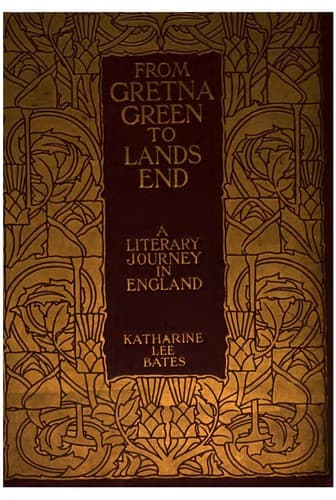
From Gretna Green to Land's End: A Literary Journey in England.Bates, Katharine Lee
General
From Gretna Green to Land's End: A Literary Journey in England.
Bates, Katharine Lee
England -- Description and travel
Earlier civil conflicts, that between Edward II and his barons, and
that holier war of liberty, won though lost, by Simon de Montfort
against his king and prince, have left graphic memories in
Herefordshire. But even these strifes seem recent beside the
battle-marks of Offa the Saxon, who built an earthen dyke, still in
fairly good preservation, from the Severn to the Wye, to keep the
Welshmen back; and beside those thick-set British camps and Roman
camps that testify to the stubborn stand of Caractacus and his Silures
against the all-conquering legions.
We were on a peaceful pilgrimage and could well dispense with visiting
Coxwall Knoll, close above Brampton-Bryan, where Caractacus met his
crushing defeat, and Sutton Walla, some five miles to the north of
Hereford, where Offa, King of the Mercians, betrayed to assassination
his guest, King Ethelbert of the East Angles; but we ought to have
sought out Holm Lacy, for the sake of the Sir Scudamour of Spenser's
"Faery Queene," and to have visited Hope End, near Ledbury, in loving
homage to Elizabeth Barrett Browning. And so we might, had it not been
for the innate depravity of man as exemplified in the dourest driver
that ever handled reins. His one aim throughout that trip was not to
go anywhere we wished. He would sometimes seem to hesitate at a
parting of the ways, but it was only to find out which road was our
desire, when as deaf and dumb to all our protests as if he knew only
the Silurian tongue, as impervious to parasol pokes as if he were
cased in Roman mail, he would take the other. The only comfort that
came to our exasperated souls was the reflection that at sundown we
could dismiss Sir Stiffback with his ill-earned shillings and never
see his iron phiz again, whereas the unfortunate women of his
household, the possible wife, sister, daughter, would have to put up
with the unflinching obduracy of that cross-grained disposition until
he went the way of Roger de Mortimer. But not even this cromlech of a
coachman, though with the worst intentions, could prevent our enjoying
the pastoral charm of the quiet land through which we drove, for this
county, as Fuller wrote, "doth share as deep as any in the alphabet of
our English commodities, though exceeding in the W for wood, wheat,
wool, and water." As for wood, we saw in Harewood Park, by which our
Clod of Wayward Marl inadvertently drove us, chestnuts and beeches
whose height and girth would do credit to California; in point of
wheat the county is said to be so fertile that, for all the wealth of
cattle, the people have not time to make their own butter and cheese;
the wool was reckoned in Fuller's time the finest of all England; and
the salmon-loved Wye, which rises, like the Severn, on the huge
Plinlymmon mountain, flows with many picturesque turns and "crankling
winds" across the county, receiving the Lug, on which Leominster is
situate, and further down, the Monnow, which forms the Monmouth
boundary.
Public-domain text, read in full here on John Shaqi.
Reviews
Reviews
No reviews yet
Be the first to share your thoughts on this work.
Elsewhere in the archive
Join the Discussion
Join the discussion
Sign in to leave a comment or review.
Sign InorCreate an account