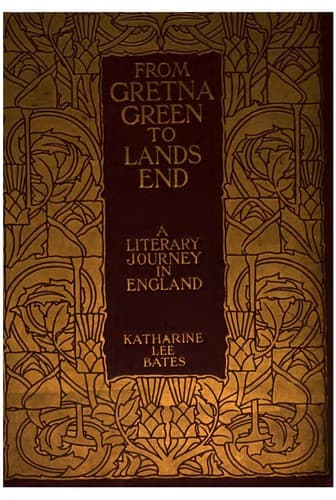
From Gretna Green to Land's End: A Literary Journey in England.Bates, Katharine Lee
General
From Gretna Green to Land's End: A Literary Journey in England.
Bates, Katharine Lee
England -- Description and travel
If this were the Hereford of the first half of the seventeenth
century, the city has dimmed a little since, yet we found it a
pleasant town enough, with the Wye murmuring beside it, and its
ancient cathedral of heroic history reposing in its midst. Garrick was
born in Hereford, and poor Nell Gwynne, and in the north transept of
the cathedral is a brass to John Philips, who endeared himself to all
the county by his poem on "Cyder." We went to see the Preaching Cross
that marks the site of a monastery of the Black Friars, neighboured
now by the Red Cross Hospital for old soldiers and servants. One of
these beneficiaries, in the prescribed "fustian suit of ginger
colour," eagerly showed us about and was sorely grieved that we could
not wait to hear his rambling chronicle to the end. The rest of our
time in Hereford outside our hostelry--the Green Dragon, most amiable
of monsters--we spent in the cathedral, an old acquaintance, but so
passing rich in beauties and in curiosities that at the end of our
swift survey we were hardly more satisfied than at the beginning. We
will come back to it some time--to the grave old church that has grown
with the centuries and, unabashed, mingles the styles of various
periods, the church in which Stephen was crowned and Ethelbert buried;
to the croziered bishops in their niches, the two great,
thirteenth-century bishops among them, D'Aquablanca, the worst of
saints with the loveliest of tombs, and Cantilupe, so godly that he
never allowed his sister to kiss him, of such healing virtues that
even sick falcons were cured at his shrine; to the Knights Templars,
mail-clad, treading down fell beasts; to the wimpled dames with
praying hands, shadowed by angel-wings; to the Chapter Library with
its chained tomes; and to that mediæval _Mappa Mundi_ (about 1313)
showing the earth with its encircling ocean, Eden and Paradise above,
and such unwonted geographical features sprinkled about as the
Phoenix, Lot's Wife, and the Burial Place of Moses.
Our surly coachman deposited us at Ross, the little border town with
houses sloping from the hilltop to the Wye, while behind and above the
mall rises a tall grey spire. Here our faith in human nature was
promptly restored by that contemplation of the virtues of The Man of
Ross which even the public-house signboards forced upon us. This John
Kyrle so lauded by Pope, was a cheery old bachelor of modest income,
the most of which he expended for the town in works of practical
benevolence, planting elms, laying out walks, placing fountains, and
caring for the poor.
"Whose cause-way parts the vale with shady rows?
Whose seats the weary traveler repose?
Who taught that heaven-directed spire to rise?
'The Man of Ross,' each lisping babe replies."
But the lisping babes are wrong as to this last particular, for Kyrle
did not build the spire, although he gave the church its gallery and
pulpit.
Public-domain text, read in full here on John Shaqi.
Reviews
Reviews
No reviews yet
Be the first to share your thoughts on this work.
Elsewhere in the archive
Join the Discussion
Join the discussion
Sign in to leave a comment or review.
Sign InorCreate an account