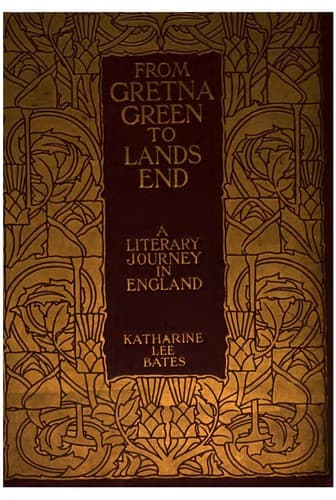
From Gretna Green to Land's End: A Literary Journey in England.Bates, Katharine Lee
General
From Gretna Green to Land's End: A Literary Journey in England.
Bates, Katharine Lee
England -- Description and travel
At Ross we ought to have taken to the water, for the scenery of the
Lower Wye, with its abrupt cliffs, rich woods, and smiling meadows, is
one of the prides of England, but we had run so far behind our dates,
by the dear fault of Shropshire, that we went on by train. The rail,
however, follows the river, and we had--or thought we had--swift
glimpses of the romantic ruins of Wilton Castle, one of the old
Border keeps, and of Goodrich castle, where Wordsworth met the little
maid of "We are Seven." This valley of the Wye, which was to the poet
Gray the delight of his eyes and "the very seat of pleasure," yields
striking effects in wooded crag and gorge at Symond's Yat, but we
enjoyed hardly less the tranquil reaches of green pasture, where the
afternoon sunshine still lay so warm that little groups of sheep were
cuddled at the foot of every tree. The ancient town of Monmouth, in
its nest of hills, reminded us not merely of its royal native, Henry
V,
--"Ay, he was born at Monmouth,
Captain Gower"--
but of that twelfth-century romancer, Geoffrey of Monmouth, whose
"History of the Britons," with its fluent account of the doings of
hitherto unheard-of kings, especially Arthur the Giant Killer and his
false queen Guanhumara, so scandalised his contemporaries that they
did not scruple to call him a "shameless and impudent liar" and to
report that legions of devils had been seen hovering over his
manuscript. About seven miles to the southwest of Monmouth is Raglan
Castle, where Charles I took refuge after Naseby. Its gallant lord,
the Marquis of Worcester, then in his eighty-fourth year, stood a
siege of ten weeks, not capitulating until the loyal little garrison,
fast diminishing, was reduced to such extremities that the horses ate
their halters for want of forage. I had visited, some fifteen years
before, those war-scarred towers, tapestried with marvellous masses of
ivy, and from the windows of the Royal Apartments had looked out on
that lovely western view in which the harassed Stuart took solace.
Lord Herbert, son of the staunch old royalist, invented and
constructed a machine, the terror of the peasantry, which has a good
claim to be counted the first steam-engine. The so-called Yellow Tower
was the scene of his wizard craft. The Great Hall now lies open to
wind and weather, and but one wall of the chapel stands, its two stone
effigies peeping out from their ivy-curtained niches.
Public-domain text, read in full here on John Shaqi.
Reviews
Reviews
No reviews yet
Be the first to share your thoughts on this work.
Elsewhere in the archive
Join the Discussion
Join the discussion
Sign in to leave a comment or review.
Sign InorCreate an account