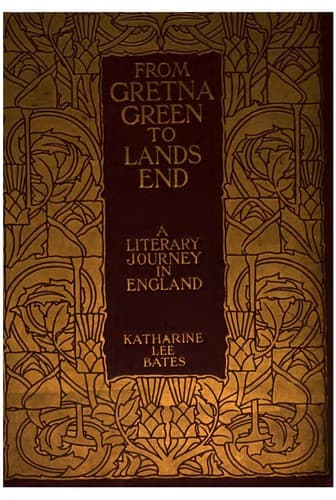
From Gretna Green to Land's End: A Literary Journey in England.Bates, Katharine Lee
General
From Gretna Green to Land's End: A Literary Journey in England.
Bates, Katharine Lee
England -- Description and travel
Tewkesbury Abbey, which outranks in size ten of the twenty-eight
English cathedrals, is one of the most illustrious churches in the
United Kingdom. Unlike most of the larger monastic establishments, it
was under the control of a succession of great families whose deeds
and misdeeds form no small part of the history of England. Fitz-Hamon,
kin to the Conqueror, swept away what buildings of the old Saxon abbey
he may have found there, and erected the magnificent Norman church
which still awes the beholder. The ashes of Fitz-Hamon, who died in
1107, rest near the High Altar. The next lord of Tewkesbury to be
buried in the Abbey was Gilbert de Clare, one of the signers of Magna
Charta. The name of his father, Richard de Clare, headed the list, and
one of the seven copies of the Great Charter was deposited in the
Abbey. Every lord of Tewkesbury after Gilbert de Clare was interred in
this church, which, for the next two hundred and fifty years, until
the lordship of Tewkesbury was absorbed into the Crown, grew ever more
splendid with costly monuments. The widow of Gilbert de Clare married
the brother of Henry III, Richard, Duke of Cornwall, but although she
thus became a countess of many titles and one of the first ladies of
the land, she asked, in dying, to be buried beside the husband of her
youth in Tewkesbury. To this her second husband would not agree, but
he was magnanimous enough to send her poor, homesick heart back to the
Abbey in a silver vase, which was duly placed in Earl Gilbert's marble
mausoleum.
The De Clares of Tewkesbury, Earls of Gloucester and Hereford, were a
warrior race. The second Gilbert, called the Red Earl, fought both
with Simon de Montfort, and against him, and the third Gilbert, his
son, fell at Bannockburn. By his early death the lordship of
Tewkesbury passed from the De Clares, who had held it for nearly a
century, to the young earl's brother-in-law, Hugh le Despencer. This
new Earl of Gloucester had succeeded Piers Gaveston in the perilous
favour of Edward II. When Roger de Mortimer, by the unhallowed aid of
Queen Isabel, triumphed over the king, the elder Despencer, a man of
ninety, was hanged at Bristol, and his son, Hugh le Despencer, crowned
with nettles, was swung from the gallows fifty feet high, in a hubbub
of mockeries and rejoicings, at Hereford. His widow collected the
scattered quarters of his body, exposed in various towns, and interred
them in the Abbey under a richly carved and coloured monument. The
Despencers, though no longer Earls of Gloucester, held the lordship of
Tewkesbury for wellnigh another hundred years, cherishing and
beautifying the fabric of the church and adding lavishly to its
memorials of bronze and marble and to its treasure of chalices, copes,
and jewels.
Public-domain text, read in full here on John Shaqi.
Reviews
Reviews
No reviews yet
Be the first to share your thoughts on this work.
Elsewhere in the archive
Join the Discussion
Join the discussion
Sign in to leave a comment or review.
Sign InorCreate an account