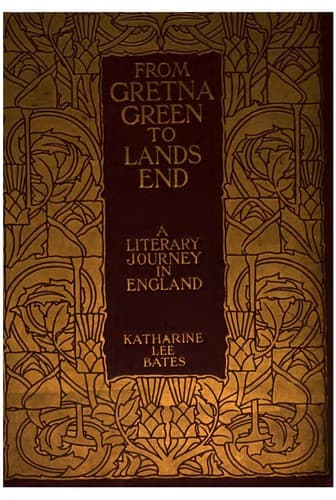
From Gretna Green to Land's End: A Literary Journey in England.Bates, Katharine Lee
General
From Gretna Green to Land's End: A Literary Journey in England.
Bates, Katharine Lee
England -- Description and travel
Early in the fifteenth century the male line of the Despencers became
extinct, and the Lady Isabel, sister of the last Lord Despencer,
succeeded to the ecclesiastical honours of the family. Married in the
Abbey at the age of eleven to Richard Beauchamp, Earl of Worcester,
she was widowed ten years later and found her solace in building an
exquisite chapel, known as the Warwick Chantry, in her husband's
memory. Her second husband, cousin to the first, was Richard
Beauchamp, Earl of Warwick, whom she commemorated in the still more
elaborate Beauchamp Chapel at Warwick; but she herself chose to lie at
Tewkesbury. Her daughter married Warwick the King-maker and became the
mother of two fair girls of most pathetic story. The elder, Isabel,
was wedded to George, Duke of Clarence, brother of Edward
III,--"false, fleeting, perjur'd Clarence,"--who is supposed to have
been murdered in the Tower through the agency of his brother
Richard--drowned, the whisper went, in a butt of Malmsey wine. A
fortnight earlier his wife and an infant child had died, probably of
poison. A son and daughter survived, who, for the royal blood that
flowed in their veins, were regarded with uneasiness by the Tudor
kings and ultimately sent to the block. The daughter, Margaret
Plantagenet, superintended the education of the Princess Mary, and was
once described by Henry VIII himself as "the most saintly woman in
England." But she was the mother of Cardinal Pole, who had angered the
tyrant and was on the Continent out of his reach; so this reverend and
gracious lady, at the age of sixty-eight, had her stately head
clumsily hacked off by a prentice executioner on Tower Hill, where her
innocent brother had perished forty-two years before. The second
daughter of the Countess Isabel had an even more pitiful life than her
sister's, for her first husband was Prince Edward, the last
Lancastrian, and then, after he had been foully slain, she strangely
accepted the hand of one of his murderers, Richard of Gloucester, the
worst of the Yorkists, by whom she was soon, it would appear, coolly
put out of the world. A favourite saying of the county, probably
having reference to the extraordinary number and wealth of its
religious houses, runs: "As sure as God is in Gloucestershire," but
one can hardly read these tragedies of Tewkesbury without feeling
that the Devil has been no infrequent sojourner there.
Public-domain text, read in full here on John Shaqi.
Reviews
Reviews
No reviews yet
Be the first to share your thoughts on this work.
Elsewhere in the archive
Join the Discussion
Join the discussion
Sign in to leave a comment or review.
Sign InorCreate an account