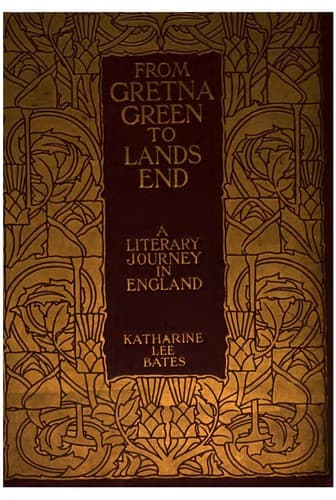
From Gretna Green to Land's End: A Literary Journey in England.Bates, Katharine Lee
General
From Gretna Green to Land's End: A Literary Journey in England.
Bates, Katharine Lee
England -- Description and travel
frankly embraced the perilous cause of the Duke of Monmouth, welcoming
him with joyous ceremonies. In Taunton market-place he was proclaimed
king, and from Taunton he issued his royal proclamations. The Duke was
utterly defeated at Sedgemoor, three miles to the east of Bridgewater,
in what Macaulay designates as "the last fight deserving the name of a
battle that has been fought on English ground." The simple Somerset
folk who had followed the banners of Monmouth were punished with
pitiless severity. The brutal officers made a jest of the executions.
A range of gibbets, with their ghastly burdens, crossed the moor, but
Taunton was the especial victim of the royal vengeance. A hundred
prisoners were put to death there by Kirke and his "lambs," and
wellnigh another hundred hanged by such process of law as was embodied
in Jeffrey's "Bloody Assize."
But we would not linger in Taunton,--no, not even for the sake of its
gentle Elizabethan poet, Samuel Daniel, nor would we stay our journey
for trips to the places of varied interest on either side. A little to
the southwest is Wellington, which gave The Iron Duke his title. Going
north from there one would come soon to Milverton, the birthplace of
Dr. Thomas Young, that ingenious linguist who first began to read the
riddle of the Sphinx; for he had deciphered some half dozen of the
Egyptian hieroglyphics in advance of Champollion's great announcement.
A few miles further to the north is Combe Flory, the pleasant
parsonage which Sidney Smith made so gay, even binding his books, and
theological books at that, in brightest colours. To get a tropical
effect, and to hoax his guests, he hung oranges from his garden
shrubs, and to gratify a lady who hinted that deer would ornament the
little park, he fitted out his two donkeys--who doubtless had their
opinion of him and of his doings--with branching antlers, and
stationed them before the windows for a pastoral effect. Well away to
the east of Taunton is Ilchester, the birthplace of that illustrious
thirteenth-century friar, Roger Bacon, a necromancer to his own
generation, and a pioneer in scientific method to ours; and near by
Ilchester is Odcombe, where Tom Coryatt, stoutest-soled of travellers,
was born. He claimed to have walked, between May and October of 1608,
no less than nineteen hundred and seventy-five miles over the
continent of Europe, and had just achieved a pilgrimage to Jerusalem
and a call on the Great Mogul when, under the eastern stars, he died.
England profited by his travels in the entertaining volume commonly
known as Coryatt's "Crudities," as well as in that foreign elegance of
table-forks which he is said to have introduced.
Public-domain text, read in full here on John Shaqi.
Reviews
Reviews
No reviews yet
Be the first to share your thoughts on this work.
Elsewhere in the archive
Join the Discussion
Join the discussion
Sign in to leave a comment or review.
Sign InorCreate an account