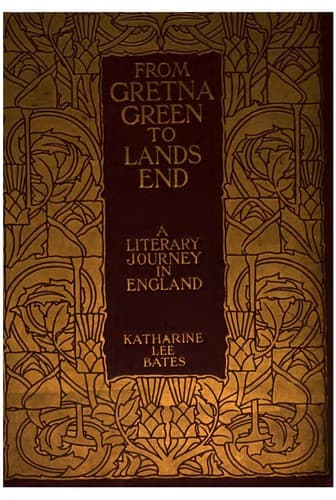
From Gretna Green to Land's End: A Literary Journey in England.Bates, Katharine Lee
General
From Gretna Green to Land's End: A Literary Journey in England.
Bates, Katharine Lee
England -- Description and travel
Dreamy hours were those we spent under the shadow of Glastonbury Tor,
among the tranquil ruins of that once so glorious abbey, strolling
about with a motley company of sheep, chickens, and tourists over what
is perhaps the most ancient consecrated ground in England. Hither came
St. Joseph of Arimathæa with his eleven companions and here the staff
of the saint, as he thrust it into the ground, put forth leaf and
blossom as a signal that the resting-place was reached. The little
wattled oratory that the Archangel Gabriel commanded and the pagan
king permitted them to build on a waste island of the marsh was
succeeded, in course of time, by a primitive form of monastery, where
St. Patrick, his mission to Ireland accomplished, dwelt many years and
died. Here in a later century great St. Dunstan held the post of abbot
and waged at his forge stern warfare against the Devil. And it is
sober history that here a Christian church and brotherhood lived on in
unbroken peace from British times to English. "What Glastonbury has to
itself, alone and without rival," says Freeman, "is its historical
position as the tie, at once national and religious, which binds the
history and memories of our race to those of the race which we
supplanted."
The after-story of Glastonbury is as tragic as that of Whalley. A
mitred abbey, enlarged and enriched from generation to generation, it
became a court whither the sons of noblemen and gentlemen were sent
for nurture in gracious manners; a school of learning whose library
was one of the most precious in the realm; a seat of princely
hospitalities and lavish charities. When the storm burst, Abbot
Whiting strove to hide from the spoilers some of the abbey plate. He
was forthwith arrested at his manor of Sharpham--the very house where
Fielding the novelist was afterwards born,--sentenced at Wells,
dragged on a hurdle to the top of Glastonbury Tor, and there hanged
and butchered, his head being spiked above the abbey gate. The
magnificent church and extensive conventual buildings, stripped and
abandoned, long served the neighbourhood as a quarry. Richly
sculptured blocks were built into barns and garden-walls and even
broken up for making a road over the marshes. Little is left for the
gazer now save a few weed-crowned columns, an exquisite Early English
chapel on the site of St. Joseph's wattled church, a gabled
tithe-barn, an old pilgrim inn, and the Abbot's Kitchen, a witchcap
structure whose four vast fireplaces must all have roared with jollity
when Abbot Whiting chanced to be entertaining five hundred "persons of
fashion" at a single dinner-party. As we wandered over the daisied
pastureland from one grey fragment to another, we realised the
invisible Glastonbury all the more in the peace that has come with the
perishing of the visible. "Time the Shadow" has but softened the
splendour. More than ever is this
Public-domain text, read in full here on John Shaqi.
Reviews
Reviews
No reviews yet
Be the first to share your thoughts on this work.
Elsewhere in the archive
Join the Discussion
Join the discussion
Sign in to leave a comment or review.
Sign InorCreate an account