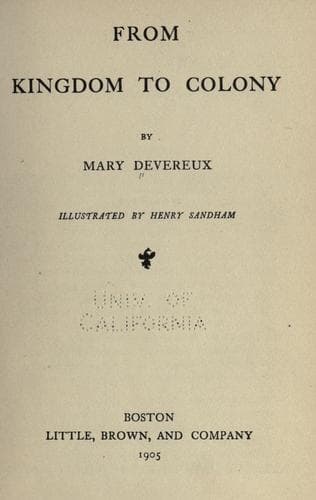
United States -- History -- Revolution, 1775-1783 -- Fiction
In July subscriptions were being solicited by order of the town of
Marblehead for the relief of the poor of Boston, who were suffering
from the operation of the "Port Bill," and all the buildings which
could be utilized, even to the town-house, were placed at the disposal
of the merchants, for the storage of their goods.
In defiance of Parliament, whose act had practically suppressed all
town meetings, the people of Marblehead continued to assemble and
express their views, and discuss the grave questions then agitating the
entire country. The very air of the sea seemed to murmur of war and
the rumors of war; and the hearts of thinking men and women were heavy
with forebodings of the struggle they felt to be imminent.
But the little town was lying brooding and peaceful this July
afternoon. Its wooded hills to the west sent shadows across the grassy
meadows and slopes, rising and falling to meet the sand-beaches, or
ending in the headlands of granite that made sightly outlooks from
which to scan the sea for threatening ships.
Under the pines that made shadows along the way, a horseman was going
leisurely along the road leading to the Fountain Inn.
To his left lay level meadow lands, rising into hills as they neared
the inn, the old Burial Hill--the town's God's Acre--being highest of
all. To his right, the green fields and marshes stretched unbroken to
the sea, save for here and there a clump of bushes and tangled vines,
or a thicket of wild roses. The road before him ended in two branches,
one leading to the rising ground on the right, where stood the Fountain
Inn, while to the left it terminated in a sandy beach, before which
stretched the peaceful waters of Little Harbor, now whitened with the
sails of East Indian commerce, and the craft belonging to the fishing
fleets that plied their yearly trade to the "Banks" and to Boston.
No large ship could come nigh the shore in Little Harbor; whereas in
the deep bay lying between the Neck and the town, the enemy's vessels
might anchor by the land itself. And here the townsfolk kept a most
active lookout, which left the hills and beaches of Little Harbor
almost deserted.
CHAPTER II
The bridle was lying slack upon the neck of the horse, who picked his
way carefully along the road, his hoofs now clicking over the stony
highway, now falling noiselessly upon the brown pine needles. And the
occasional clatter of his shoes, or the busy chatter of a squirrel high
up in a tree, were the only sounds to interrupt the musings of the
stalwart rider, whose head was bowed, and whose eyes strayed moodily
about.
He was dark and tall, well knit, and of powerful build, yet lithe and
graceful. The wandering breeze whipped out stray curling locks about
his ears and temples from the mass of dark hair done up in a queue.
The broad-brimmed riding-hat was pulled well down over his strongly
marked brows, and the smooth-shaven face betrayed the compressed lips
of the large but finely formed mouth.
Public-domain text, read in full here on John Shaqi.
Reviews
Reviews
No reviews yet
Be the first to share your thoughts on this work.
Join the Discussion
Join the discussion
Sign in to leave a comment or review.
Sign InorCreate an account