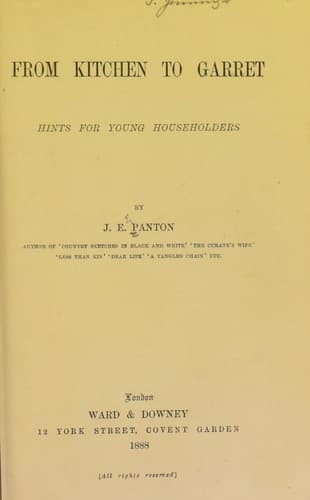
From Kitchen to Garret: Hints for young householdersPanton, J. E. (Jane Ellen)
General
From Kitchen to Garret: Hints for young householders
Panton, J. E. (Jane Ellen)
Home economics
We are no advocates for spoiling servants, any more than we should be
for spoiling children, yet we are anxious that they should be happy; and
that they may be happy it is necessary that we have a set of rules that
must be kept, and that they should gradually learn that we wish to stand
in the same relation to them, while they are in our house, as their
parents would were they still in their care.
Rule the first is, that no young servant should be out alone after dark,
giving reasons for this rule that are easily understood. Rule the
second, that no one comes to the back door after a certain hour, because
their friends are quite welcome to come to the front door, and once it
is dark bad characters are about, and young girls are easily frightened;
and rule the third, in which all the rest are comprehended, is that they
must learn that we are always ready to hear all their hopes and fears,
to help them choose their hats and dresses, to assist them in every way
they wish, and to give them sympathy and kindness, which we will take
from them in our turn should we be ill or in trouble.
How much more cheerfully will the cook help you to retrench if, instead
of scolding about the waste, you ask her to help you to save what would
otherwise be given or thrown away. And much more pleasantly will your
housemaids help you when ‘company comes,’ if you tell them to look out
for this or that celebrity, to listen if Miss Smith sings or if Mr.
Brown plays; and how much they will do should you leave one or two of
the pleasanter parts of preparing in their hands, preferring rather an
ill-arranged flower vase than the idea that all the rough and none of
the smooth falls to their share of the work. It will not hurt us to do a
little dusting for once, or even to wash the china, and indeed it will
do us good, for it will teach us how monotonous and wearisome is the
work by which our ‘maidens,’ the dear old Dorset expression for our
servants, earn their daily bread, but that ceases to have half its
monotony and irksomeness should we help occasionally, when work is
pressing, and there is more than usual to do. To have good and loving
servants, then, it is necessary to have them tolerably young, to be
firm, kind, and, above all, sympathetic, to know as much about their
home life as is possible; and without telling them much, yet, when it is
advisable, to take them into our confidence, secure in our turn of
receiving sympathy, which is always precious, no matter from whom it is
received.
Public-domain text, read in full here on John Shaqi.
Reviews
Reviews
No reviews yet
Be the first to share your thoughts on this work.
Elsewhere in the archive
Join the Discussion
Join the discussion
Sign in to leave a comment or review.
Sign InorCreate an account