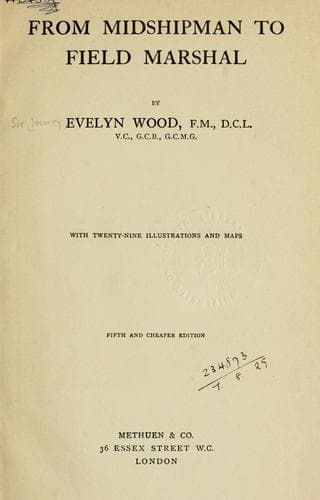
Great Britain -- History, Military -- 19th century; Marshals -- Great Britain -- Biography; Wood, Evelyn, 1838-1919
When we opened fire, being very proud of ourselves, we named that
part of the 21-gun battery, the guns of which were manned by sailors,
the Koh-i-noor Battery, a play on the name of Captain Peel’s ship,
H.M.S. _Diamond_. “Koh-i-noor” was painted in black letters on a white
signboard, and near it was hoisted a Union Jack in the centre of our
section of half the battery. Neither the board nor the Union Jack
remained after an hour’s firing. As wood and paint were scarce, we gave
up the board; but the flag-staff was replaced again and again. Captain
Peel refixed it twice on the 17th, and in replacing it on the 18th I
had a curious escape. The battery was built on a slightly descending
slope, about that of St. James’s Street, London, S.W., and as the flag
stood above the trench or big ditch which formed the battery, shots
just missing the top of the parapet, which was about four feet above
the surface of the ground, often cut the flag-staff or one of its
supports. When the pole had been much reduced in length by its numerous
fractures, we fastened the flag on to a spare rammer. This rammer was
cut away on the 18th, and as I did not like to remain in sight of the
enemy while digging a fresh hole, I collected some trucks or wheels of
guns’ carriages which had been injured, and in them placed the rammer
with the flag, filling up the space with stones and fragments of broken
shell. I was just putting the finishing touches to what I thought would
give a firm hold, when a shot struck the pile of trucks, and cut them
down to the ground.
Public-domain text, read in full here on John Shaqi.
Reviews
Reviews
No reviews yet
Be the first to share your thoughts on this work.
Join the Discussion
Join the discussion
Sign in to leave a comment or review.
Sign InorCreate an account