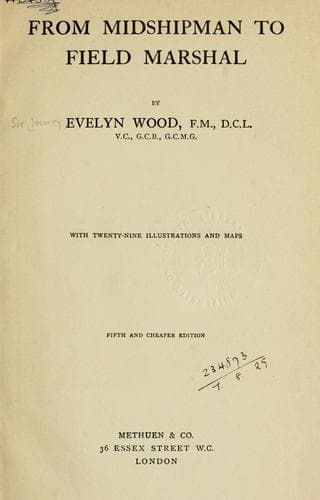
Great Britain -- History, Military -- 19th century; Marshals -- Great Britain -- Biography; Wood, Evelyn, 1838-1919
The arrangements for the Assault contemplated that 800 men, covered by
the fire of about 200 skirmishers, were to advance a distance of 400
to 500 yards over open ground, accompanied by men carrying ladders 18
feet in length. The Orders issued after dark detailed the 34th Regiment
as Storming party, and detachments were ordered to form the Supports,
which were lying down before daylight immediately outside the 8-gun
battery, about 300 yards in the rear of the Ladder party. All had
orders to move out when the flag was hoisted in the 8-gun battery,
where Lord Raglan stood.
In my _Crimea 1854-’94_, I gave a full account of the operations on
the 18th June, showing the arrangements for the Assault were faulty;
here I limit myself to stating what happened to the column which
I accompanied. The sad story of the failure, although not perhaps
interesting to civilian readers, can be studied with advantage by
soldiers who may have to conduct a similar operation.
When the French went out from their trenches, 7 officers, 60 Petty
officers, and Bluejackets, of the Right Naval Brigade Ladder party,
were all crouching close together, as much under cover as possible,
behind a bank two feet high. I was lying next to Mr. Parsons, a Mate,
when suddenly he knocked against me violently, and as I thought in
rough play. I was asking him to leave off skylarking, when I noticed
he was insensible; he had been thrown over by a round-shot, which had
killed another man and covered me with dust.
Next to Captain Peel’s detachment of 60 men was a party of soldiers
of similar strength, and 50 men carrying wool bags. These were either
volunteers or picked men of the Rifle Brigade, and in the words of
their gallant leader, Captain (afterwards Sir E. W.) Blackett, “among
the best in the battalion.” While we were waiting for the signal, a
mortar-shell fell amidst the storming party, and blew a soldier and
his accoutrements into the air. When taking my eyes off the body as
it fell, I saw the signal flag as it was being run up, before it was
“Broken,”[36] and shouting “Flag’s up,” jumped on the little bank which
had sheltered us, thus inducing a shower of grape and musketry, which
knocked down several men.
The Russians now manned their parapets, and thence poured on us a
succession of steadily aimed volleys. Captain Wolseley,[37] who was
standing near Lord Raglan,[38] said when he saw the masses of Russians
facing our little body of men, “There is no hope for them.”
It is difficult to describe adequately the intensity of the fire.
Various kinds of projectiles cut up the ground all around us, but not
continuously in their fullest force, for while there was no cessation
of the shower of missiles, which pattered on the ground like tropical
rain when the monsoon breaks, at times there were death-dealing gusts
of increased density, which swept down the hill, felling our men as a
reaping-machine levels standing crops.
Public-domain text, read in full here on John Shaqi.
Reviews
Reviews
No reviews yet
Be the first to share your thoughts on this work.
Elsewhere in the archive
Join the Discussion
Join the discussion
Sign in to leave a comment or review.
Sign InorCreate an account