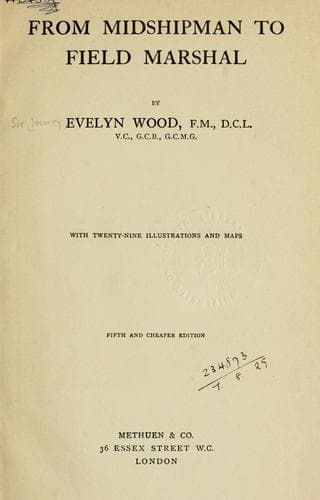
Great Britain -- History, Military -- 19th century; Marshals -- Great Britain -- Biography; Wood, Evelyn, 1838-1919
Brevet-Major Arthur Tremayne was the next Senior, and the guiding star
of the Regiment. He had taken a degree at a University, and had kept
up his classical attainments, reading Greek and Latin with facility
and pleasure. He was comfortably off for a bachelor, and I owe much to
his thoughtful kindness. He not only lent me all his books, but bought
many which he persuaded himself he wanted, because he thought that it
would improve my knowledge of our profession. I occupied all my spare
time, when not soldiering or engaged in sports, in reading early in the
morning, and late at night, so as to make up for the five years I had
been away from school; for while I was on board the _Queen_ I spent
most of my time aloft at sea, and in the boats when the ship was at
anchor. I read a considerable amount of English Military History, and
with Tremayne’s help went through Virgil. I had done the Twelve Books
before I left Marlborough, but on recommencing in 1857 I find I looked
out absolutely every word in the first page, for I have still got the
interleaved edition I used. Clement helped me in Arithmetic, in which
I was deplorably ignorant. These two men and Stanley Clarke, who was
often away on leave, being very popular in society, made my spare hours
pass pleasantly.
When the Victoria Cross Gazette of the 24th February reached Ireland,
my messmates were very sympathetic with my disappointment; they had
read Lord Lyons’ speech[51] of the 13th February in the previous year,
when at Scutari, where I was then lying in Hospital. I had always hoped
that this warm praise from the Naval Commander-in-Chief, coupled with
the speech[52] of the Commodore in May 1855, would ensure my receiving
the Decoration. Under the advice of the Adjutant, who reflected the
view of my messmates, I wrote to the Adjutant-General, reporting what
the Commodore, Sir Stephen Lushington, had read out on Parade in the
Crimea, and learnt from the Equerry of the Commander-in-Chief that the
letter had been duly forwarded to the Admiralty. I cannot remember to
have received an official reply, but knew at the time that one of the
Lords of the Admiralty was strongly in favour of the Navy following,
in granting it to men who had left the Service, the procedure of the
Army, but the First Lord held the Cross was not only a reward, but an
incentive to valour. In spite of the remonstrances of Captain Peel,
Sir Stephen Lushington, and later of Lord Lyons, who when he returned
from the Mediterranean went to the Admiralty to endeavour to get the
decision reversed, it was maintained.
Public-domain text, read in full here on John Shaqi.
Reviews
Reviews
No reviews yet
Be the first to share your thoughts on this work.
Elsewhere in the archive
Join the Discussion
Join the discussion
Sign in to leave a comment or review.
Sign InorCreate an account