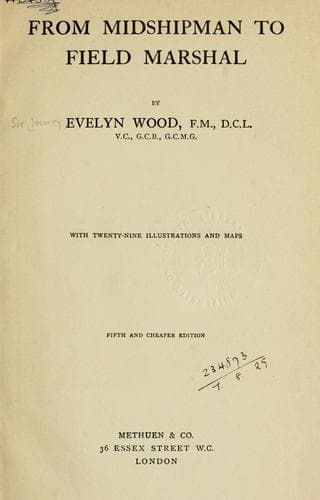
Great Britain -- History, Military -- 19th century; Marshals -- Great Britain -- Biography; Wood, Evelyn, 1838-1919
All through the Spring of the year I was troubled by the want of money,
and found it difficult to live within my income, not so much because of
the ordinary expenses, for my brother-officers had generously declined
to allow me to continue to pay for wine except on guest-nights, but on
account of the number of small compulsory charges. The Horse Guards was
issuing sumptuary Regulations for the reduction of expenditure, as is
being done at the present time, and on the 18th July we had our first
half-crown dinner; but a new pattern frock-coat and other expenditure
was impending, and although officially the Regiments were told the cost
of the Stable jacket was to be cut down, being replaced by a cheaper
form, yet eleven Commanding officers protesting, were told in the month
of June, in the War Office, that they need not trouble themselves, as
the jacket would not be altered.
I made up my mind to leave the Cavalry for the Infantry, or to take
service abroad, for choice in the Foreign Legion in Algeria; but before
I took any steps in the matter news from India turned my thoughts to
the East. We got to Newbridge on the 4th May, being quartered with the
3rd Light Dragoons and a battery of Horse Artillery. My life would
have been very pleasant there, but for the long hours spent at the
Mess table, the General, a “two-bottle” man, frequently dining with
us. My letters often record having sat at table from 7 till 10.40 in
his honour, which to a water drinker was trying. I was not the only
sufferer, for many of my messmates wanted to smoke, which was rigidly
forbidden in the Mess-room, and cigars only were allowed in the
anteroom; cigarettes were unknown; the cheapest cigars in the Mess were
sixpence, and although I have never smoked I proposed at a Mess meeting
that pipes should be allowed after dinner in the ante-room, but no one
was bold enough to second it.
The Assistant Adjutant-General, Major and Brevet-Lieutenant Colonel
Morris, 17th Lancers, at the Curragh had studied at the Senior
Department, Sandhurst, and added greatly to the interest of our
Military exercises by the schemes he gave us to work out. We re-fought
many actions of Frederick the Great, and some of Wellington’s Peninsula
battles, which induced reading, and served to weaken, if not to break
down the Mess rule of “No shop” at table.
Colonel Morris was, however, ahead of the Generals, and after he had
pointed out that the Horse Artillery should have advanced previous to a
charge and come into action against the troops to be attacked, we were
startled by the Generals’ decision, that the Horse Artillery should
have _charged_ with the Cavalry.
Public-domain text, read in full here on John Shaqi.
Reviews
Reviews
No reviews yet
Be the first to share your thoughts on this work.
Elsewhere in the archive
Join the Discussion
Join the discussion
Sign in to leave a comment or review.
Sign InorCreate an account