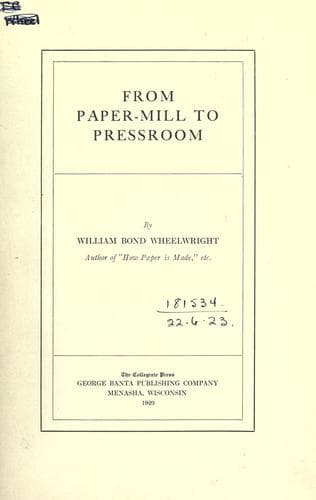
From Paper-mill to PressroomWheelwright, William Bond
Philosophy
From Paper-mill to Pressroom
Wheelwright, William Bond
Papermaking
[2] Included in “All other.”
[3] Included with other wood by species.
The high point of importation of chemical wood-pulp was reached in
1914, when approximately 3,600,000 tons came in from Europe and 92,000
from Canada. In January 1916 owing to the war, imports for the month
from Europe dropped from an average of 30,694 tons to 12,985 tons,
while Canadian pulp increased from an average of 7,654 to an actual
importation for the month of 28,833 tons.
Although the use of wood now so heavily overshadows that of rags that
it almost seems as though the latter were being slowly abandoned, this
is of course only relatively true, their consumption being actually
greater than ever. The mere cost of the rags in 1909 was slightly in
excess of the total value of all paper products recorded in the United
States Census for 1850, a circumstance which leads us to wonder at the
timely discoveries which made wood cellulose available.
It is evident, however, that to some extent paper history is already
beginning to repeat itself. The visible supplies of wood are markedly
less, as evidenced by their increasing costs, and we are forced to a
much more active attitude than one of mere speculation as to what new
sources may become available to supply our demand for paper, which has
lately been increasing in the value of the annual products by almost 11
per cent.
In the decade from 1899 to 1909 shown by government statistics,
book-paper advanced 104 per cent in quantity, but 120 per cent in
value; writing-paper, 88 per cent in quantity, but 104 per cent in
value; wrapping-paper, 43 per cent in quantity and 72 per cent in
value. It is true that rising wages account in part for these changes
in value, but above and behind all this stands the inexorable law of
supply and demand.
The discrepancies between the percentages of increase in production
and value serve to emphasize the increasing difficulties in obtaining
raw material. That sprucewood is being consumed in this country faster
than it is grown, is indicated by the recourse to less-favored species,
as well as by the steadily increasing imports, both of pulpwood and
wood-pulp. This situation emphasises the great importance of conserving
waste papers, in spite of the fact that 21.4 per cent of the fiber
used in 1909 in the United States were derived from waste papers.
Vast quantities may readily be saved which now go to waste, as was
definitely proved by England’s experience during the war, when the
imports of pulp were shut off and immediate substitutes had to be found.
This is a matter demanding the attention not only of printers, but of
municipalities and nations. It offers an immediate source of relief
from the drain on our forests and is hence a most practical form of
conservation. Furthermore as demonstrated by the city of Cleveland
the revenue from collecting waste papers assists substantially in
offsetting the cost of the collection of municipal wastes.
CHAPTER THREE
Public-domain text, read in full here on John Shaqi.
Reviews
Reviews
No reviews yet
Be the first to share your thoughts on this work.
Join the Discussion
Join the discussion
Sign in to leave a comment or review.
Sign InorCreate an account