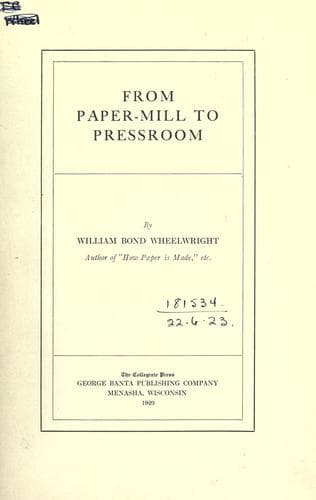
From Paper-mill to PressroomWheelwright, William Bond
Philosophy
From Paper-mill to Pressroom
Wheelwright, William Bond
Papermaking
Broadly speaking, there are five steps in the manufacture of paper:
1. The isolation of the paper-making fiber from the raw material.
2. The conversion of the fiber into pulp.
3. The beating and refining of the fiber, and the admixture of
non-fibrous components.
4. The manufacture of the mixture into paper.
5. The finishing of the paper and its preparation for the market.
Cotton and linen rags, hemp, woods and plants each require their
peculiar treatments. Cotton and linen, being the original paper-making
fibers, will be considered first.
RAG STOCK.
Rag papers may be made from all sorts and conditions of rags, so the
fineness of the finished product depends upon the newness and quality
of the rags. New white cuttings from textile factories are the best, as
their strength is unimpaired by previous use, and they may be prepared
for manufacture with a minimum use of chemicals.
From this high standard, rags are graded down in accordance with their
color, cleanliness and condition. The first sortings are made by
stock-dealers, and the paper-maker orders whatever grades are suitable
to his purpose. After their receipt at the mill, the bales of rags are
opened, dusted by machine and distributed to girls, who sort them, open
up the seams so as to release hidden dirt, remove buttons and other
foreign material.
In the making of the highest grades, the new white rags are cut by hand
into small pieces of uniform size, but ordinarily they are fed into a
mechanical rag cutter. After this they are passed through a dusting
machine to rid them as far as possible from dirt and foreign matter,
which might otherwise appear as specks in the paper.
BOILING.--Dyes and greasy matters are associated with the fibers, and
in order to obtain the pure cellulose fiber the rags are cooked, under
steam pressure, in rotary boilers with alkali. This saponifies and
dissolves the non-cellulose compounds, and the soda in combination
with these soluble materials is subsequently washed out. The amount
of steam pressure, the quantity of chemicals, and the duration of the
cooking, are subject to variation under different conditions. At the
conclusion of the process the manholes in the boilers are opened, and
the contents are deposited on the floor, later to be transferred to the
washer room.
Public-domain text, read in full here on John Shaqi.
Reviews
Reviews
No reviews yet
Be the first to share your thoughts on this work.
Join the Discussion
Join the discussion
Sign in to leave a comment or review.
Sign InorCreate an account