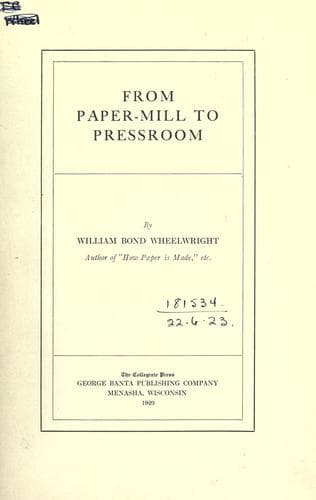
From Paper-mill to PressroomWheelwright, William Bond
Philosophy
From Paper-mill to Pressroom
Wheelwright, William Bond
Papermaking
CONDITIONS BEYOND ABSOLUTE CONTROL.--Believing it to be impracticable
to leave the precise normal moisture in machine-made paper, I have
deliberately refrained from classifying this difficulty with faults
chargeable to manufacture, and the general recognition of this
circumstance indicates the wisdom of ordering paper long enough in
advance to permit of a period of seasoning. In fact, this phenomenon
of expansion or contraction of cellulose fibers places difficulties
originating from this source in the class of conditions beyond absolute
human control, but a study and understanding of the subject will
enable one to prevent, or at least to minimize, such troubles. It
consequently becomes the business of the printer to inform himself as
thoroughly as possible on the subject. Static electricity is an element
beyond absolute control and the source of much trouble. Both phenomena
could be controlled by proper atmospheric conditions in storage and
press rooms, but it is an expensive matter to equip rooms and install
the necessary apparatus. The amount of trouble arising from these
elements is often sufficiently costly in time and material to warrant
investigation as to the expense involved.
The least a printer can do is to maintain hygrometers in his pressroom
so as to keep track of atmospheric variations, and be guided
accordingly.
STATIC ELECTRICITY IN PAPER
Among the “paper troubles” due to conditions for which neither the
paper-maker nor the printer is responsible, none is more bothersome
than the presence of static electricity in paper. These static charges,
which are created by friction either in the making or handling of
paper, develop magnetic propensities in the sheets, causing them to
behave in ways which seem nothing but freakish until their nature is
understood. Some sheets stick together as if they were glued, while
others appear repellent to one another. Likewise, they may act in the
same manner toward the fly-bars of the press. It is next to impossible
to “feed” sheets so charged, and there is every likelihood of the ink
from one sheet offsetting to another.
Every one familiar with the magnet knows that there are in magnetism
two poles, the positive and the negative; that two substances of
opposite polarity attract one another, but that substances of the
same polarity repel each other. Static electricity--or frictional
electricity, as it is also called--exists both in positive and negative
charges, and sheets of paper containing static charges are governed
accordingly.
Paper, when dry, is an insulator to electricity, but when moist it
becomes an excellent conductor. Consequently, too much drying in
manufacture increases the likelihood of electrical troubles, because it
makes the paper more retentive of electricity with which it may become
charged.
Public-domain text, read in full here on John Shaqi.
Reviews
Reviews
No reviews yet
Be the first to share your thoughts on this work.
Join the Discussion
Join the discussion
Sign in to leave a comment or review.
Sign InorCreate an account