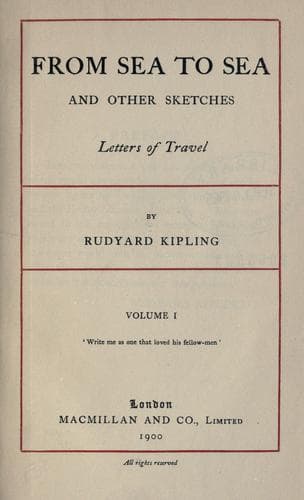
From Sea to Sea; Letters of TravelKipling, Rudyard
General
From Sea to Sea; Letters of Travel
Kipling, Rudyard
Asia -- Description and travel; Kipling, Rudyard, 1865-1936 -- Travel; United States -- Description and travel; Voyages and travels
In the evening when the jackals were scuttling across the roads and the
cranes had gone to roost, came Deoli the desolate, and an unpleasant
meeting. Six days away from his kind had bred in a Cockney heart a
great desire to see a fellow-subject. An elaborate loaf through the
cantonment--fifteen minutes' walk from end to end--showed only one
distant dog-cart and a small English child with an ayah. There was grass
in the soldierly straight roads, and some of the cross-cuts had never
been used at all since the days when the cantonment had been first laid
out. In the western corner lay the cemetery--the only carefully tended
and newly whitewashed thing in this God-forgotten place. Some years ago
a man had said good-by to the Englishman; adding cheerily: "We shall
meet again. The world's a very little place y' know."
His prophecy was a true one, for the two met indeed, but the prophet was
lying in Deoli Cemetery near the well, which is decorated so
ecclesiastically with funeral urns.
XIX
COMES BACK TO THE RAILWAY, AFTER REFLECTIONS ON THE MANAGEMENT OF THE
EMPIRE; AND SO HOME AGAIN, WITH APOLOGY TO ALL WHO HAVE READ THUS FAR.
In the morning the tonga rattled past Deoli Cemetery into the open,
where the Deoli Irregulars were drilling. They marked the beginning of
civilisation and white shirts; and so they seemed altogether detestable.
Yet another day's jolting, enlivened by the philosophy of Ram Baksh, and
then came Nasirabad. The last pair of ponies suggested serious thought.
They had covered eighteen miles at an average speed of eight miles an
hour, and were well-conditioned little rats. "A Colonel Sahib gave me
this one for a present," said Ram Baksh, flicking the near one. "It was
his child's pony. The child was five years old." When he went away, the
Colonel Sahib said: "Ram Baksh, you are a good man. Never have I seen
such a good man. This horse is yours." Ram Baksh was getting a horse's
work out of a child's pony. Surely we in India work the land much as the
Colonel Sahib worked his son's mount; making it do child's work when so
much more can be screwed out of it. A native and a native State deals
otherwise with horse and holding. Perhaps our extreme scrupulousness in
handling may be statecraft, but, after even a short sojourn in places
which are dealt with not so tenderly, it seems absurd. There are States
where things are done, and done without protest, that would make the
hair of the educated native stand on end with horror. These things are
of course not expedient to write; because their publication would give a
great deal of unnecessary pain and heart-searching to estimable native
administrators who have the hope of a Star before their eyes and would
not better matters in the least.
Public-domain text, read in full here on John Shaqi.
Reviews
Reviews
No reviews yet
Be the first to share your thoughts on this work.
Elsewhere in the archive
Join the Discussion
Join the discussion
Sign in to leave a comment or review.
Sign InorCreate an account