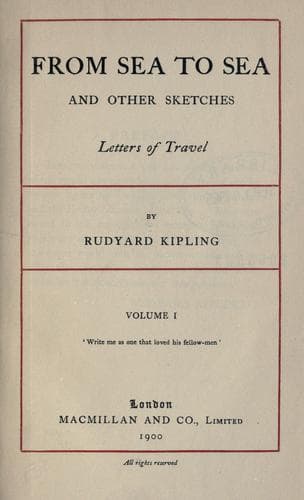
From Sea to Sea; Letters of TravelKipling, Rudyard
General
From Sea to Sea; Letters of Travel
Kipling, Rudyard
Asia -- Description and travel; Kipling, Rudyard, 1865-1936 -- Travel; United States -- Description and travel; Voyages and travels
Note this fact though. With the exception of such journals as, occupying
a central position in British territory, levy blackmail from the
neighbouring States, there are no independent papers in Rajputana. A
King may start a weekly, to encourage a taste for Sanskrit and high
Hindi, or a Prince may create a Court Chronicle; but that is all. A
"free press" is not allowed, and this the native journalist knows. With
good management he can, keeping under the shadow of our flag, raise two
hundred rupees from a big man here, and five hundred from a rich man
there, but he does not establish himself across the Border. To one who
has reason to hold a stubborn disbelief in even the elementary morality
of the native press, this bashfulness and lack of enterprise is amusing.
But to return to the native States' administrations. There is nothing
exactly wrong in the methods of government that are overlaid with
English terms and forms. They are vigorous, in certain points; and where
they are not vigorous, there is a cheery happy-go-luckiness about the
arrangement that must be seen to be understood. The shift and play of a
man's fortune across the Border is as sudden as anything in the days of
Haroun-al-Raschid of blessed memory, and there are stories, to be got
for the unearthing, as wild and as improbable as those in the _Thousand
and One Nights_. Most impressive of all is the way in which the country
is "used," and its elasticity under pressure. In the good old days the
Durbar raised everything it could from the people, and the King spent as
much as ever he could on his personal pleasures. Now the institution of
the Political agent has stopped the grabbing, for which, by the way,
some of the monarchs are not in the least grateful--and smoothed the
outward face of things. But there is still a difference, between our
ways and the ways of the other places. A year spent among native States
ought to send a man back to the Decencies and the Law Courts and the
Rights of the Subject with a supreme contempt for those who rave about
the oppressions of our brutal bureaucracy. One month nearly taught an
average Englishman that it was the proper thing to smite anybody of mean
aspect and obstructive tendencies on the mouth with a shoe. Hear what an
intelligent loafer said. His words are at least as valuable as these
babblings. He was, as usual, wonderfully drunk, and the gift of speech
came upon him. The conversation--he was a great politician, this
loafer--had turned on the poverty of India. "Poor?" said he. "Of course,
it's poor. Oh, yes, d----d poor. And I'm poor, an' you're poor,
altogether. Do you expect people will give you money without you ask
'em? No, I tell you, Sir, there's enough money in India to pave Hell
with if you could only get at it. I've kep' servants in my day. Did they
ever leave me without a hundred or a hundred and fifty rupees put
by--and never touched? You mark that. Does any black man who had been
Public-domain text, read in full here on John Shaqi.
Reviews
Reviews
No reviews yet
Be the first to share your thoughts on this work.
Elsewhere in the archive
Join the Discussion
Join the discussion
Sign in to leave a comment or review.
Sign InorCreate an account