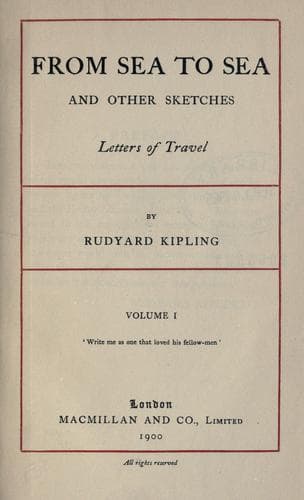
From Sea to Sea; Letters of TravelKipling, Rudyard
General
From Sea to Sea; Letters of Travel
Kipling, Rudyard
Asia -- Description and travel; Kipling, Rudyard, 1865-1936 -- Travel; United States -- Description and travel; Voyages and travels
The Englishman was hunting for the statue of a horse, a great horse
hight Hunja, who was a steed of Irak, and a King's gift to Rao Omeda,
one time monarch of Boondi. He found it in the city square as Tod had
said; and it was an unlovely statue, carven after the dropsical fashion
of later Hindu art. No one seemed to know anything about it. A little
further on, one cried from a byway in rusty English: "Come and see my
Dispensary." There are only two men in Boondi who speak English. One is
the head, and the other the assistant, teacher of the English side of
Boondi Free School. The third was, some twenty years ago, a pupil of the
Lahore Medical College when that institution was young; and he only
remembered a word here and there. He was head of the Charitable
Dispensary; and insisted upon, then and there, organising a small levee
and pulling out all his books. Escape was hopeless: nothing less than a
formal inspection and introduction to all the native physicians would
serve. There were sixteen beds in and about the courtyard, and between
twenty and thirty out-patients stood in attendance. Making allowances
for untouched Orientalism, the Dispensary is a good one, and must
relieve a certain amount of human misery. There is no other in all
Boondi. The operation-book, kept in English, showed the principal
complaints of the country. They were: "Asthama," "Numonia,"
"Skindiseas," "Dabalaty" and "Loin-bite." This last item occurred again
and again--three and four cases per week--and it was not until the
Doctor said "_Sher se mara_" that the Englishman read it aright. It was
"lion-bite," or tiger, if you insist upon zoological accuracy. There was
one incorrigible idiot, a handsome young man, naked as the day, who sat
in the sunshine, shivering and pressing his hands to his head. "I have
given him blisters and setons--have tried native and English treatment
for two years, but it is no use. He is always as you see him, and now he
stays here by the favour of the Durbar, which is a very good and pitiful
Durbar," said the Doctor. There were many such pensioners of the
Durbar--men afflicted with chronic "asthama" who stayed "by favour," and
were kindly treated. They were resting in the sunshine their hands on
their knees, sure that their daily dole of grain and tobacco and opium
would be forthcoming. "All folk, even little children, eat opium here,"
said the Doctor, and the diet-book proved it. After
laborious-investigation of everything, down to the last indent to Bombay
for Europe medicines, the Englishman was suffered to depart. "Sir, I
thank ...," began the Native Doctor, but the rest of the sentence stuck.
Sixteen years in Boondi does not increase knowledge of English; and he
went back to his patients, gravely conning over the name of the
Principal of the Lahore Medical School--a College now--who had taught
him all he knew, and to whom he intended to write. There was something
pathetic in the man's catching at news from the outside world of men he
Public-domain text, read in full here on John Shaqi.
Reviews
Reviews
No reviews yet
Be the first to share your thoughts on this work.
Elsewhere in the archive
Join the Discussion
Join the discussion
Sign in to leave a comment or review.
Sign InorCreate an account