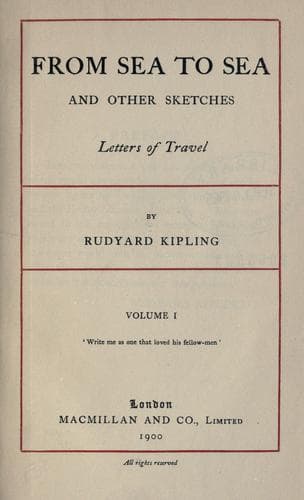
From Sea to Sea; Letters of TravelKipling, Rudyard
General
From Sea to Sea; Letters of Travel
Kipling, Rudyard
Asia -- Description and travel; Kipling, Rudyard, 1865-1936 -- Travel; United States -- Description and travel; Voyages and travels
had known as Assistant and House Surgeons who are now Rai Bahadurs, and
his parade of the few shreds of English that still clung to him. May he
treat "loin-bites" and "catrack" successfully for many years. In the
happy, indolent fashion that must have merits which we cannot
understand, he is doing a good work, and the Durbar allows his
Dispensary as much as it wants.
Close to the Dispensary stood the Free School, and thither an
importunate _munshi_ steered the Englishman, who, by this time, was
beginning to persuade herself that he really was an accredited agent of
Government, sent to report on the progress of Boondi. From a
peepul-shaded courtyard came a clamour of young voices. Thirty or forty
little ones, from five to eight years old, were sitting in an open
verandah learning accounts and Hindustani, said the teacher. No need to
ask from what castes they came, for it was written on their faces that
they were Mahajans, Oswals, Aggerwals, and in one or two cases, it
seemed, Sharawaks of Guzerat. They were learning the business of their
lives, and, in time, would take their father's places, and show in how
many ways money might be manipulated. Here the profession-type came out
with startling distinctness. Through the chubbiness of almost babyhood,
or the delicate suppleness of maturer years, in mouth and eyes and
hands, it betrayed itself. The Rahtor, who comes of a fighting stock, is
a fine animal, and well bred; the Hara, who seems to be more compactly
built, is also a fine animal; but for a race that show blood in every
line of their frame, from the arch of the instep to the modelling of the
head, the financial--trading is too coarse a word--the financial class
of Rajputana appears to be the most remarkable. Later in life may become
clouded with fat jowl and paunch; but in his youth, his quick-eyed,
nimble youth, the young Marwar, to give him his business title, is
really a thing of beauty. His manners are courtly. The bare ground and a
few slates sufficed for the children who were merely learning the ropes
that drag States; but the English class, of boys from ten to twelve, was
supplied with real benches and forms and a table with a cloth top. The
assistant teacher, for the head was on leave, was a self-taught man of
Boondi, young and delicate looking, who preferred reading to speaking
English. His youngsters were supplied with "The Third English Reading
Book," and were painfully thumbing their way through a doggerel poem
about an "old man with hoary hair." One boy, bolder than the rest, slung
an English sentence at the visitor, and collapsed. It was his little
stock-in-trade, and the rest regarded him enviously. The Durbar supports
the school, which is entirely free and open; a just distinction being
maintained between the various castes. The old race prejudice against
payment for knowledge came out in reply to a question. "You must not
sell teaching," said the teacher; and the class murmured applausively,
"You must not sell teaching."
Public-domain text, read in full here on John Shaqi.
Reviews
Reviews
No reviews yet
Be the first to share your thoughts on this work.
Elsewhere in the archive
Join the Discussion
Join the discussion
Sign in to leave a comment or review.
Sign InorCreate an account