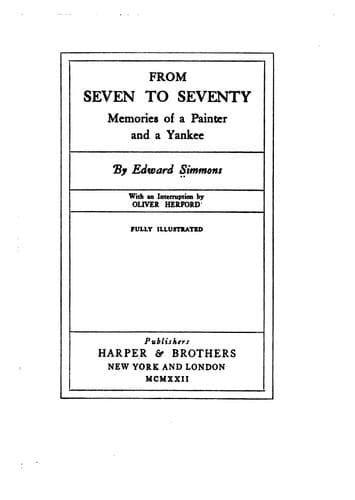
From Seven to Seventy: Memories of a Painter and a YankeeSimmons, Edward
General
From Seven to Seventy: Memories of a Painter and a Yankee
Simmons, Edward
Artists -- Biography
Right in back of my studio, which was a storehouse for pilchard nets and
consequently on the sea, was the old graveyard. Here the stanch
Cornishmen were buried four or five layers deep, and occasionally the
tide would wash a hole in the wall, scattering the bones, and rolling
skulls up and down the beach. The new graveyard was much more modern,
with a careful division between the Church of England and the
Dissenters, the different entrances separated, as I think my dear mother
thought heaven was—one gate for the Unitarians and one for the remainder
of the world. I remember a carpenter who accidently cut off his thumb.
He was not nearly so worried about the pain as that he might go through
all eternity thumbless; so he anxiously saved the piece and, waiting
until there was a funeral, dropped it into the grave, being very
careful, however, that it was on the Dissenter side of the cemetery (he
being a Wesleyan preacher on Sunday). The picture of any part of his
body wandering around in a Church of England heaven was something he
could not bear to contemplate.
The Cornish have some peculiar uses of the English language, some of the
expressions going back to the Elizabethan period. They never use an
objective, but say “to I” or “for we”; then there is “on” for “in” and
“coolth” and “dryth.” “Minching” means stealing or playing hooky and
comes from the same source as “Miching mallecho” of Shakespeare.
Nearly the entire life of these people is spent in the fishing industry,
as it is in Concarneau; only here the pilchard takes the place of the
sardine. All along the shore are built little whitewashed cabins,
glistening in the distance like seagulls. Here, during the fishing
season, men sit all day long, watching for that unmistakable faint
purple ruff on the water that indicates the run of fish. At the first
sign they stand upon the cliff and wave the branch of a tree. Everyone
quits work; children rush up and down the shore, waving green branches
and shouting the fishing call at the top of their voices. If you look
out upon the water you can see a place where the “hair of the animal”
has been rubbed the wrong way. There is great rivalry as to which
company gets the best schools of fish, and they row madly to beat one
another, sometimes having very serious fights. The costume is very
different from that of the Bretons, the men wearing tarpaulins and high
boots; but the catch is just as large, sometimes taking three days to
empty the large circular nets that have been drawn up like a purse.
When I went to St. Ives it was unknown as an art colony, the place where
they gathered being Penzance, about ten miles away. Whistler had been
there two years before, but Robinson was the sole representative of the
clan upon my arrival. When I left, five years later, there was an Art
Club of one hundred members. The term “Cornish school” came into being
from a remark of Stanhope Forbes to Whistler’s enemy, Harry Quilter, the
critic, who asked:
Public-domain text, read in full here on John Shaqi.
Reviews
Reviews
No reviews yet
Be the first to share your thoughts on this work.
Elsewhere in the archive
Join the Discussion
Join the discussion
Sign in to leave a comment or review.
Sign InorCreate an account