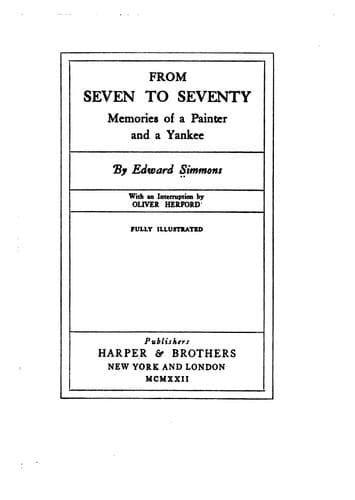
From Seven to Seventy: Memories of a Painter and a YankeeSimmons, Edward
General
From Seven to Seventy: Memories of a Painter and a Yankee
Simmons, Edward
Artists -- Biography
“Why do all you men of the Cornish school paint alike?”
(They were all painters who had studied in France and learned their
trade.)
“We use the same model,” answered Forbes.
“Ah, that’s it! Who is she?”
“Nature.”
Seeing this colony form in St. Ives made me study out how such things
happen. The artist finds a place that is beautiful, undiscovered, and
suits his pocketbook. He goes there for two years. The third year other
artists follow him; the fourth year come the retired British admirals
and “vamps”; the fifth year the artist leaves; the sixth come the
wealthy people who spend a lot of money on it, making it as ugly and
dear as possible, but soon tire and go away. Then the artist comes back
again and begins all over, picking the bones of what the Money Bags had
killed.
The home of Leslie Stephen, in St. Ives, was the gathering place for all
sorts of interesting persons. He married Thackeray’s daughter, knew many
notables, and was the biographer of most of them. He entertained such
men as E. W. Gosse, the critic and brother-in-law of Alma Tadema, the
famous painter of finished Greek subjects. It always seemed to me so
extraordinary to see one of his Greek slaves with manicured toenails,
leaning up against a marble column upon which you could see the polish,
with a truly Bostonian expression on her face!
Curious to say, I met Lowell here, and, although he immediately called
me “Edward” and spoke of my mother as “Mary,” I did not remember him at
Concord, and was ignorant enough not to know much about his work. One
day Stephen remarked that music, like eating, should be done in the
bathroom. It always sounded to him like an infernal din. He was the
ultra-literary type, who wished to be rid of all things physical; he
even envied Harriet Martineau, who had no sense of taste. Lowell said:
“Edward, this foolish friend of mine really has some excellent Scotch
whisky. Come away with me. If you listen to him you will surely be
contaminated.”
Mental corruption for a young man was much worse in his opinion than
teaching him to drink Scotch whisky.
I remember walking with Lowell and my uncle when the conversation
drifted to walking sticks. My uncle said he had cut his on the grave of
Wordsworth. I sniffed and said it was not half so good a stick as mine
and that if it had been cut on the grave of Shakespeare it would have no
added value for me. Lowell turned and said:
“My boy, you are like most of the great men of the world—lacking in one
quality, that of deference—and _all_ the fools.” Considering that I had
heard of this poet in his youth, marching through the streets of
Cambridge with the young woman to whom he was betrothed, draped in
white, with wreaths upon their heads, and the people in the procession
cheering, as a tribute to virginity, I could not help but think: Is it
better, I wonder, for a young man to be lacking in deference or a sense
of humor?
Public-domain text, read in full here on John Shaqi.
Reviews
Reviews
No reviews yet
Be the first to share your thoughts on this work.
Elsewhere in the archive
Join the Discussion
Join the discussion
Sign in to leave a comment or review.
Sign InorCreate an account