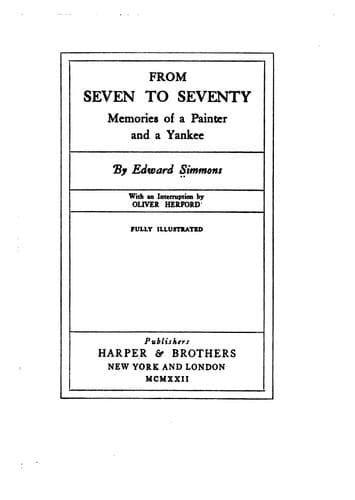
From Seven to Seventy: Memories of a Painter and a YankeeSimmons, Edward
General
From Seven to Seventy: Memories of a Painter and a Yankee
Simmons, Edward
Artists -- Biography
I never knew Zorn to get angry; he was as smooth as cream, but always
gave his absolute opinion when asked for it, and always expected others
to do the same. Quite a contrast to a well-known American artist who
wanted to turn me out of his house because I did not praise everything
he showed me. I asked:
“What did you ask me here for, to give you compliments?”
“Yes,” he answered.
The first thing Zorn painted in oils he did out of the window of his
little stone house on the embankment overlooking the bay and island. I
helped him set his palette, and he jokingly called himself my pupil (I
had told him what materials to buy), being as peevish as a child when I
dared to criticize the fact he had put the moon in the due north.
“But don’t you think it looks well?” he said. This canvas was bought by
the French government and now hangs in the Luxembourg.
Zorn was one of those artists who are always showing much originality in
the use of their materials and combining this with a sense of humor,
which often produces fine results. I went into his back yard one day,
and he had a six-foot water color leaning against the house, and was
throwing pails of water on it—“bringing it together.” He had a great
success at the Grosvenor Gallery with a picture of boats, sails, masts,
and the seashore sand, with a fat fish-wife walking toward one. (In
those days he thought the only beautiful women were fat ones.) He laid
this on a box hedge in the garden when a thunderstorm came up. We all
rushed out and it seemed to me ruined.
“Now I can make a fine picture,” he said. He painted out the smudges
from the sails and fixed the dirty sky, but in the foreground, in the
sands, were large spots of raindrops. These he turned into footprints,
and their naturalness has been commented upon more than once.
One of the most exquisite things he ever made, and one of the greatest
works of art, considering its size and sentiment, was a little carving
of poplar wood about four by six inches in size. A feather bed, in the
center of which, as if she had been dropped there, was a tiny naked
figure, sitting up, playing with her wedding ring—the most eerie, fairy
creature, with not a touch of the salacious.
Zorn never really got over the sin of water color. He was an all around
artist, but hung next to Sargent’s his portraits had all the life taken
out of them. He did not seem to go beneath the skin except in his
etchings, which are perfect, but had a wonderful dexterity and absolute
truthfulness combined with an artistic eye that refused to see anything
ugly. He once did a portrait of a woman seated on a plush sofa, which
looked like the traditional boarding-house affair—thumbed wood, worn,
and not pleasant in color. The picture gives you an idea of a beautiful
piece of furniture. I said:
“You did not harm the sofa any, did you?”
“Mine is a copy,” he replied. He would not deny the truth, but being a
gentleman, did not call names.
Public-domain text, read in full here on John Shaqi.
Reviews
Reviews
No reviews yet
Be the first to share your thoughts on this work.
Elsewhere in the archive
Join the Discussion
Join the discussion
Sign in to leave a comment or review.
Sign InorCreate an account