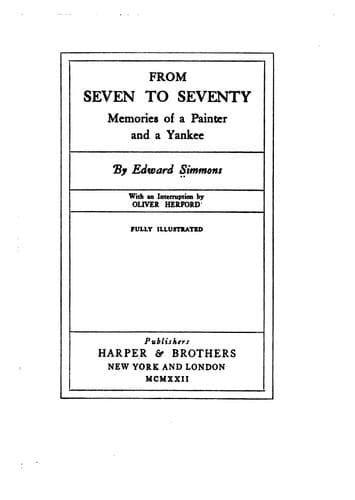
From Seven to Seventy: Memories of a Painter and a YankeeSimmons, Edward
General
From Seven to Seventy: Memories of a Painter and a Yankee
Simmons, Edward
Artists -- Biography
It would not be fair to leave St. Ives without mentioning Mr. Knill. It
is true, he lived many years before my time, but he left a permanent
money legacy and a personality so redolent with humor that he will never
be forgotten. He was not serious, even in death, and built his tomb long
before his demise—a large crypt and granite sarcophagus with his coat of
arms—upon the top of a hill as a landmark for his smuggling fleet to get
into harbor. Having completed this, he made his will. He directed that
every five years there should be given ten pounds to the oldest widower,
ten to the oldest widow, ten to the town fiddler, and ten each to ten
young virgins, provided they all joined hands and danced around his tomb
(led by the fiddler) to the tune of “Old Hundred.”
This celebration had developed into a pathetic thing. They selected the
poor who needed the money and the dinner, which originally was to cost
two pounds a plate, but had been reduced to two shillings, even the
Cornish not being above a little unpardonable economy. The whole thing
was very English, and just like the lichen which comes on a tree when it
is old.
One of the greatest jokes Mr. Knill played upon the populace was to go
to London and die in a hospital, so that his body was dissected by the
medical students. I was telling this to a crowd of Londoners, saying
that it was such a joke that he should have painted as his motto on his
tomb:
NIL DESPERANDUM.
“Yes,” they said, “but you see his name was spelled with a ‘K.’”
London is a male, a great, gloomy being, sitting up on his island,
rough, unshaven, besmeared with cinders and smut, and glowering across
at the courtesan Paris as she graciously smiles back at him with every
wile. For Paris is a woman.
In London nobody wants to see you. There is a “get out” sign on the side
of every wall, and broken glass on the top. Even the weather frowns on
you, making you feel that you are not wanted. But in Paris, the very
first man you meet, from the cab driver to the waiter in the café, is
very glad to see you and gives you the impression that you are his
personal guest. On the north side of the Channel, the Atlantic Ocean
roars like an infuriated bull, while on the south side it hurls itself
against the coast like an angry woman. In fact, all the male
characteristics are those of London—dignity, strength, coarseness, and
brute force—but in Paris there is never a trace of these. There is only
charm.
Public-domain text, read in full here on John Shaqi.
Reviews
Reviews
No reviews yet
Be the first to share your thoughts on this work.
Elsewhere in the archive
Join the Discussion
Join the discussion
Sign in to leave a comment or review.
Sign InorCreate an account