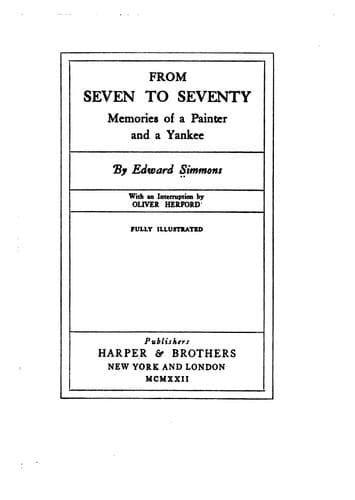
From Seven to Seventy: Memories of a Painter and a YankeeSimmons, Edward
General
From Seven to Seventy: Memories of a Painter and a Yankee
Simmons, Edward
Artists -- Biography
Paris never shocks you. There is much low life and there is crime, but
it is treated in an artistic way. Every so often they have a wholesale
raid to get rid of the undesirables. At a stated time, on a summer
evening, suddenly will come marching down all the streets which lead to
the tenderloin district hundreds of police, walking four abreast and
making a dragnet which sweeps everything before it. Everyone who cannot
tell his business, any solitary woman, is caught in its meshes and
brought up before the authorities. I was sitting in the Café Américain
one night, with a drink before me, when a woman in an evening gown
rushed frantically up to my table, saying:
“You are my brother.”
Nothing loath, I took the cue, but asked, “What is it you want to do?”
“Oh, don’t you know what is happening?” she said. “It is the _cordon_.”
She took my arm and I escorted her to the door, she all the time
protesting her eternal gratitude. If she had been seized alone by the
police, that last shame would have been hers. She would have been “put
on the card” and become automatically a registered prostitute.
Nothing like this happens in London. There, in the first dusk of
evening, little girls hardly twelve years old walk past the Criterion
Bar and the Haymarket, dressed in long skirts, smirking and smiling and
proclaiming their profession to any male they happen to meet. These
children are unmolested, and no one seems to object to it in the least,
although their manner and language are disgusting as well as pitiable.
Then again there are the old women, drunken, disorderly creatures,
always ready to engage a chance loiterer in conversation and taking the
opportunity to whisper vulgar remarks in his ear; their flabby bodies
and flying wisps of coarse gray hair and the ages of vice in their
countenances almost denying their human origin. But to all of this
London is blissfully unconscious—it is merely the gross side of a
male—and, as such, is ignored.
My first visit to London was when I was still a student in Paris. I was
given one hundred dollars by a patron, evidently with the best
intentions, to go across the Channel and paint a portrait of the last of
the old-fashioned tallyho-coach drivers. I was a stranger in a strange
city; I had never felt the frosted shoulder before. Every other place I
had been, even in the north of California, I had been able to make
myself at home almost instantly, but here in the country of my
ancestors, where every man was as near to me in blood as the people of
Concord, Massachusetts, I was as much an alien as if I had been of
Oriental origin. I managed to locate the coachman and found him an
interesting character, but I could not make any arrangements about
painting him; it was impossible to do it in his house. I could not find
a studio, and before I had hardly turned around I found my pile reduced
to about thirty-five shillings. I decided it was about time to go back
to my friends.
Public-domain text, read in full here on John Shaqi.
Reviews
Reviews
No reviews yet
Be the first to share your thoughts on this work.
Elsewhere in the archive
Join the Discussion
Join the discussion
Sign in to leave a comment or review.
Sign InorCreate an account