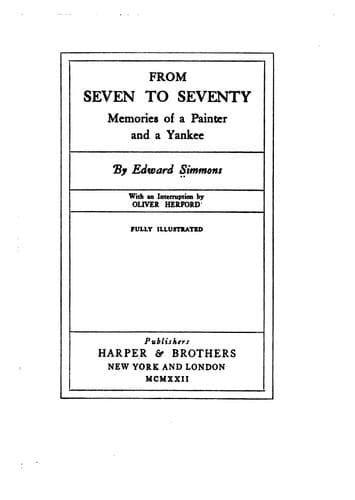
From Seven to Seventy: Memories of a Painter and a YankeeSimmons, Edward
General
From Seven to Seventy: Memories of a Painter and a Yankee
Simmons, Edward
Artists -- Biography
The next year I took courage and sent another canvas to the Academy—this
time an inoffensive thing of an old man kissing his wife good-by—which I
called “Darby and Joan.” Through some mistake, it was marked “sold” in
the book which is left on a table to give the record of sales. Some of
my friends seeing this, and having it confirmed by the person in charge,
telegraphed me congratulations, I being away down in Cornwall. It was
customary to notify the artist as soon as a sale was consummated and, as
I heard nothing, I wrote to the secretary (whom we always called “Pants
Exclusively,” on account of his tradesman instincts) and asked him to
confirm it. He answered that one of the officials had marked the book by
mistake and that the picture was not sold. I wrote and asked him to take
it off the book and to advertise it as “still for sale.” No answer. All
through that exhibition my picture was hung and marked “sold,” thereby
preventing anyone else from buying it, and this in spite of the fact
that I wrote to protest about it three times. Then I did a terrible
thing! I issued a writ against the Royal Academy! British honor was
sullied, British institutions had been assailed. Never before had anyone
dared to invoke the law against that august and distinguished body—the
Royal Academy!
[Illustration:
“THE CARPENTER’S SON”
Hitherto unpublished photograph of the painting by Edward Simmons, now
hanging on the walls of the home of Miss Amelia Jones, New Bedford,
Massachusetts
_Copyright by Edward Simmons; from a Copley Print, Copyright by Curtis
& Cameron, Publishers, Boston_
]
My final letter ran something like this:
DEAR SIR—In my country, when dealing with gentlemen, I get an
answer. In dealing with you, I do not. I appeal to the law.
I received a most pathetic letter from “Pants Exclusively” and a large,
formidable parchment apology from the trustees of the Academy.
In the meantime the London papers burst out with indignant articles
against the person who had dared to sue the Academy, calling him all
sorts of names and saying it was a bit of “cheap American advertising.”
Immediately a flock of reporters came down to Cornwall, all ready to
start a beautiful fight. I produced my parchment apology, resulting in
the gentle fading away of newspaper representatives and a lovely article
about me in the next morning’s papers.
This carelessness of the Academy had been going on for years. I had
known of several similar cases where the artist supposed his work had
been sold and was afterwards told it was a mistake. One year a friend of
mine, with true artistic optimism, gave a large dinner party to
celebrate his good luck, and, of course, expected to settle for it with
the check he was to receive. He was months paying for that dinner. At
that he may have been lucky. He at least got his picture back. There
were many lost and never returned, and any protest from the painter only
met with indifferent silence.
Public-domain text, read in full here on John Shaqi.
Reviews
Reviews
No reviews yet
Be the first to share your thoughts on this work.
Elsewhere in the archive
Join the Discussion
Join the discussion
Sign in to leave a comment or review.
Sign InorCreate an account