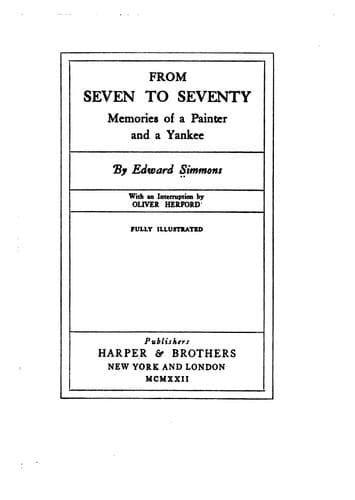
From Seven to Seventy: Memories of a Painter and a YankeeSimmons, Edward
General
From Seven to Seventy: Memories of a Painter and a Yankee
Simmons, Edward
Artists -- Biography
The English are sentimental, though—especially where they do not
understand—and, yes, I shall have to admit it, so are we of New England.
Sitting in the drawing-room of a prominent British woman, I was
astonished to hear her say, upon the announcement that a pianist was
about to play a well-known selection of Mendelssohn: “Songs Without any
Words! What a pity!” In painting they prefer canvases that have some
literary significance; a story with a heart appeal frequently attracts
more attention than a far greater work that is more abstract.
The year after Sargent had exhibited his “El Jaleo” in the Salon, his
close friend, Ralph Curtis, was bothered to death by all the busybodies
who wanted to know what the next picture would be. One day Curtis
answered:
“I’ll tell you. Sargent is painting, for the Salon, a circle of naked
women sitting on red velvet cushions, called ‘Daughters of Sin.’”
“But he can’t send it to the Academy afterward,” they cried.
“Oh yes, he can!” replied Curtis. “He’ll just change the title to
‘Waiting for the Omnibus,’ and they will never think to look at the
painting.”
There was always a great deal of talk about Sargent’s titles. At Paris
in ’89, I was dining at Stanley Reinhart’s with a number of men when
some one spoke of the portrait painter’s Academy picture of that year.
It was a beautiful thing of girls hanging Japanese lanterns in a garden
of flowers at twilight. They said he had called it, “Carnation, lily,
lily, rose.” I said at once, “Damnation, silly, silly, pose.” They
thought it quite a joke, and some one wrote to Abbey about it, who
answered that Luke Fildes had made that remark three weeks ago. His
thought must have been almost simultaneous with mine, he in England and
I in France. This shows how people may be falsely accused of plagiarism.
Of my own pictures, there was one of an old man with two children gazing
out to sea, which I had named “Low Tide.” My mother called upon the
English tailor who bought it, as she had never happened to see it. He
was very polite and treated her with great reverence, and then proceeded
to explain her son’s work to her.
“You see, the old man has just returned from sea and the little girl has
laid her hand on his arm, telling him that his daughter and her
mother—has passed away during his absence. It is called, ‘Mother’s
Dead.’”
Public-domain text, read in full here on John Shaqi.
Reviews
Reviews
No reviews yet
Be the first to share your thoughts on this work.
Elsewhere in the archive
Join the Discussion
Join the discussion
Sign in to leave a comment or review.
Sign InorCreate an account