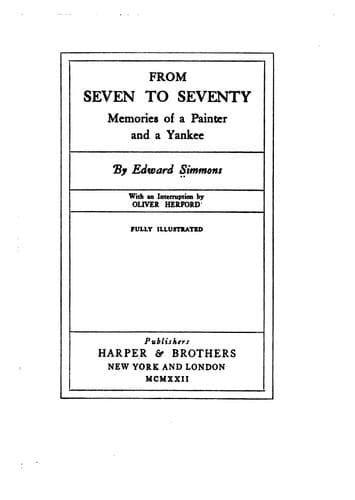
From Seven to Seventy: Memories of a Painter and a YankeeSimmons, Edward
General
From Seven to Seventy: Memories of a Painter and a Yankee
Simmons, Edward
Artists -- Biography
Babcock, an American painter, had lived there for twenty years. He was
one of those beings who had been soured by time and had come to know
that the world was all wrong. He almost always went out of his back
door, and if ever he emerged from the front it was in the dead of night.
He had sat at the feet of Millet and had a portfolio of twenty or thirty
drawings that the great artist had thrown away. He told me with joy that
Millet would crumple up his self-condemned work and throw it into a box
behind the stove. Every once in a while Babcock would fish out one and
open it up, Millet yelling at him all the time. Nothing daunted, he
would retreat like a dog with a bone. Even the garbage can is not sacred
to some people.
In Boston, Millet has been overrated (W. M. Hunt did it). Once he sold a
picture for two thousand francs, the highest price he had received up to
that time. He was most human and, like all artists, optimistic, so he
immediately hired a professor to come out from Paris and tutor his
children, and hired saddle horses for them to ride upon in the park. Of
course, this period of affluence did not last, and when he died, at
about fifty-nine years of age, he was supposed to be a poor man, cursed
by fate; yet he had received an order from the Pope and decorations from
his own government. This is not a case of neglected genius.
I was still under thirty when I met Mrs. Millet. She immediately asked:
“You paint? Then might I, as an older woman, give a bit of advice?
Remember you run the risk of making any woman you marry unhappy.” (I can
hear her voice now, as we sat at the table d’hôte.) “A woman who marries
an artist must realize beforehand that he will never care for her alone.
She must look forward always to playing second fiddle to something else.
If he is a true artist, it is his painting, if not—but she will always
be second fiddle just the same. If she has the capacity to adapt herself
to that position, she will be happy. I, myself, have been a happy
woman.”
Robert Louis Stevenson had just left Barbizon a short time before my
first visit. I was avid to hear about him and tried in vain to get them
to give me some details of his character and personality. But all the
boys said, indifferently:
“Oh yes, he writes, but his cousin is much the cleverer author.” And
they had read the _Lodging for the Night_! Not a very good
recommendation for the literary acumen of painters.
We led a lazy life out there, with rarely a tinge of excitement. We were
all in the same financial class and, I imagine, in about the same state
of blissful innocence and ignorance of the world. I remember a very
pretty girl of the Paris gay life, who was advised to go to Barbizon for
a rest and to freshen up a bit. We were thrilled at her appearance and
entertained her as if she were a _grande dame_. She was evidently in no
way pleased, but very much puzzled, when she went back to Paris and told
a friend:
Public-domain text, read in full here on John Shaqi.
Reviews
Reviews
No reviews yet
Be the first to share your thoughts on this work.
Elsewhere in the archive
Join the Discussion
Join the discussion
Sign in to leave a comment or review.
Sign InorCreate an account