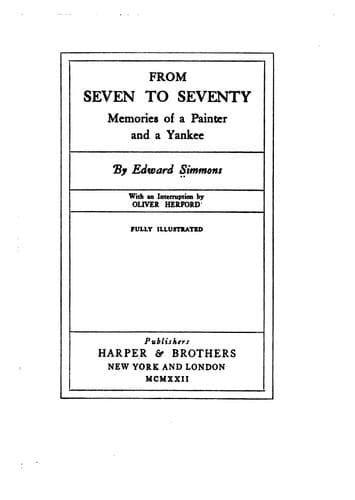
From Seven to Seventy: Memories of a Painter and a YankeeSimmons, Edward
General
From Seven to Seventy: Memories of a Painter and a Yankee
Simmons, Edward
Artists -- Biography
“_Crois tu, ma chere, pas un de ces cochons la m’ont offert le sous!_”
We made most of our own good times. One favorite game at Sirons was to
go out, each one of us, and lean a sketch against a tree, retire to a
hiding place, and watch. Of a lovely afternoon, myriads of carriages
would come out from Fontainebleau, the occupants leisurely lying back
and gazing from side to side. Some of them would spy the painting there
on the ground. If they looked at it, it counted one point; if they
examined it carefully, it was two; but if they carried it off with them
it was a sign that the painter was one hundred per cent perfect and he
had to pay for a bottle of wine for the crowd. I once had one of my
sketches taken away and it cost me two bottles of fizz, but I was a very
happy man. Some one had liked my work and had stolen it! And what was
one sketch? It was so easy to make another.
A man, perhaps not so well known as the Barbizon painters, but certainly
much more interesting than the majority of them, was Professor Lainey.
He looked an old man when I knew him, white haired and a chatterbox. For
years he had taught drawing in the schools of Fontainebleau.
In his youth Professor Lainey had hoped to become an actor and had
joined a class to study for the stage. Among the pupils was a little
Jewess, fourteen years old, plain looking and poorly dressed, and as it
was his fate to take the same omnibus with her, politeness demanded that
he escort her to her door. This he hated to do, as she was a most
hopeless-looking creature and he was cad enough to be ashamed to be seen
with her. One day in class, the teacher asked her to deliver a line of
Racine, and said:
“Shall I give it as I was told to, or as it should be rendered?”
Very amused, he replied: “Mademoiselle will be good enough to give it
first as she has been told to give it, and afterward the class will be
delighted to hear her improvement.”
She obeyed, and Professor Lainey added: “For the first time I understood
Racine.”
Continuing, he said: “I saw no more of her until I was an art student in
Paris. One night I went to the Théâtre Français, and there upon the
stage appeared the little Jewess of my class. She was none other then
the divine Sarah!”
Poor, plain, and of a despised race, even as a child her brain had begun
to work. Like Christ, as a boy before the elders, she told _them_, not
they her.
Public-domain text, read in full here on John Shaqi.
Reviews
Reviews
No reviews yet
Be the first to share your thoughts on this work.
Elsewhere in the archive
Join the Discussion
Join the discussion
Sign in to leave a comment or review.
Sign InorCreate an account