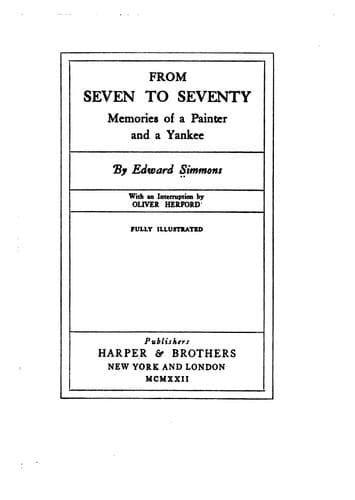
From Seven to Seventy: Memories of a Painter and a YankeeSimmons, Edward
General
From Seven to Seventy: Memories of a Painter and a Yankee
Simmons, Edward
Artists -- Biography
During one of these sieges, there was a drought inside the wall, and
they were forced to brave the enemy and get their water from one of the
many springs out upon the hillside. Thinking it better to save the
fighting men for sterner duty, it was decided to let the clerks and
those who wrote in the books go for the supply. There was one _petit
clerc_, noted for the beauty of his singing in church, who was beloved
of a girl of high birth. These two met but seldom, as their affair was
not approved by the young woman’s family. One night the clerk’s name was
on the list of those who must go outside the gates. His sweetheart found
it out and, stealing the message before it was delivered to him, she put
on boy’s clothing and took his place. That night the English lay in wait
and killed a dozen or more water carriers, throwing the bodies into the
spring. This was supposed to have stopped the flow of the water, and
to-day the inhabitants will show the sink in the side of a hill which
used to be this spring. I have always wanted to dig down and see if a
girl’s skeleton were there.
Standing on this wall, I could not help being hypnotized by the
surroundings into a feeling that it was not the nineteenth, but the
fifteenth or sixteenth century. I could see, with my mind’s eye, coming
up the valleys toward the walled town, a long line of men and laden
beasts, a troop of soldiery returning to their nest with the spoils, the
loot raped from the countryside; for as neither printing nor powder had
come to their aid, the countryfolk were robbed of everything they had
but their shift and their pickax. Led, perchance, by Sieur Johan or my
lord high bishop, they bore upon their saddlebows beautiful maidens with
streaming hair, their heads drooping and their hands tied behind their
backs.
At the end of one of the streets of Montreuil, quite a distance down,
there is a church which seems to be covered with lichens, but on nearer
approach they are seen to be bullet holes—mute testimonials to the
sufferings the people have endured during the ages—for example, the
result of the French Commune.
Public-domain text, read in full here on John Shaqi.
Reviews
Reviews
No reviews yet
Be the first to share your thoughts on this work.
Elsewhere in the archive
Join the Discussion
Join the discussion
Sign in to leave a comment or review.
Sign InorCreate an account