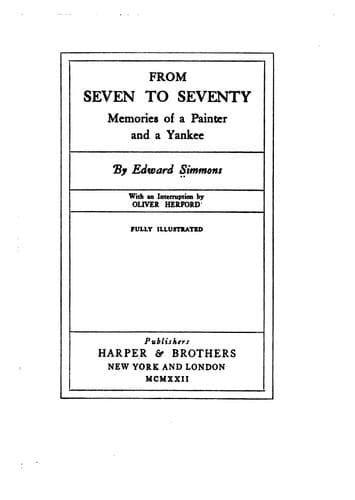
From Seven to Seventy: Memories of a Painter and a YankeeSimmons, Edward
General
From Seven to Seventy: Memories of a Painter and a Yankee
Simmons, Edward
Artists -- Biography
I slept in the inn made famous by Laurence Sterne. It was here that he
stopped near the beginning of his Sentimental Journey and hired his
valet. On its wall in large copper letters were the figures 1640,
indicating that it had been built in that year. It was a fitting place
to stop on a quest of romance, and, indeed, one could not be surprised
at any strange adventure that might overtake one in such a memory-laden
setting. Even the bedroom (I wondered if it were the same that Sterne
occupied) was of a charm and quaintness that was conducive to the most
extravagant dreams. The furniture and fixings breathed of the long ago,
and all about in convenient nooks and crannies were bits of old brass
for which any collector would give a king’s ransom. But best of all (and
these were evidently placed so that they would be the first things upon
which the sleep-laden eyes of the lodger would rest when he was awakened
by the early morning noises), was the decoration around the foot of the
bedroom wall. In solemn procession, and reaching to a height of about
five or six feet, were illustrated the gods and goddesses of Olympus! I
have always wanted to do a room like this.
_IV. Grez_
Grez has been immortalized by the artists that have stopped there. The
bridge, built over the river Loing, which was so much like the Concord
that it was a constant delight to me, has been painted times
innumerable, but it is so charming that we never tire of seeing it on
canvas.
The story of Grez is the story of nearly every French village, and one
has only to notice the way it is laid out to visualize its history.
There is one central street upon which the houses face so close together
as to form a solid wall on either side. In the back of this phalanx of
stone the whole life of the community goes on. Here are the gardens,
many of them sloping down to the river, where are the stones upon which
they wash their clothes; here the children play, protected from all
harm. The cultivated fields lie away up on the hillsides, as do the
pastures, but in olden times, before the last ray of the sun had left
the sky, every evening would see each inhabitant of the village back in
his home, close to his neighbors, protected not only from the roaming
wild animals, but from the lord upon the hill as well. The wolves were
the scavengers and nightly used to clear the little street of all its
refuse, so that anything thrown out of the window (and everything was)
had disappeared in the morning light.
Public-domain text, read in full here on John Shaqi.
Reviews
Reviews
No reviews yet
Be the first to share your thoughts on this work.
Elsewhere in the archive
Join the Discussion
Join the discussion
Sign in to leave a comment or review.
Sign InorCreate an account