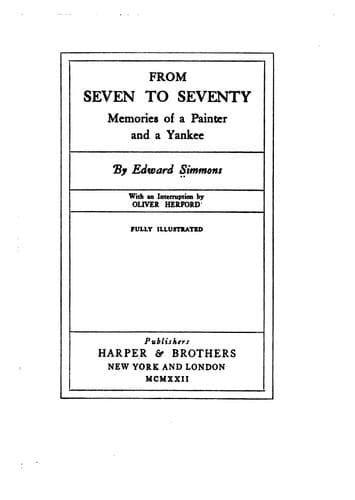
From Seven to Seventy: Memories of a Painter and a YankeeSimmons, Edward
General
From Seven to Seventy: Memories of a Painter and a Yankee
Simmons, Edward
Artists -- Biography
At ten one morning, when the first pilot boat loomed into sight and I
leaned over the rail and saw these men in oilskins busying themselves
about the craft, my calm, joyous attitude suddenly deserted me. The
thought had burst into my mind that this boat must have put out from New
York and these men were Americans. My heart came up in my throat and I
had to go below. At four o’clock that afternoon we docked, and as I
walked away from the ship, all the familiar sights and sounds coming
upon me with a rush; I stopped and, utterly unmindful that I might be
run in for a lunatic, kissed the post of the Ninth Avenue Elevated.
Homesickness and love of my native land, qualities I did not realize
that I possessed, had taken hold of me.
New York had never been my home before, so I did not know it well enough
to recognize much change; but from ’91 until the present day the city
has altered beyond recognition. A Dutch banker once told me that if the
money that his countrymen paid the Indians for the island of Manhattan
had been put out to interest, it would be sufficient to purchase the
land to-day. I wonder if that be true?
Most of the life of those days centered about Union Square, with
tentacles reaching down to Washington and up to Madison Squares. On the
Seventeenth Street side of Fourth Avenue was the Clarendon, and,
opposite, the Everett House, that famous rendezvous for politicians. On
Twenty-third Street was the Academy of Art, which housed itself in a
building evidently copied from the Doge’s palace in Venice, while next
to it was the Lyceum Theater, upon the stage of which most of the famous
actors of the day played at one time or another.
Niblo’s Garden, in what would be downtown Broadway to-day, was another
famous amusement place, but of a different character. The owner had a
large private box which was always filled with parties of friends. It
was practically on the stage, and one could reach down and touch the
shoulders or heads of the chorus girls. Behind it was a reception room,
and a bathroom with a stairway which led to the green room, and here
many gay suppers took place after the show.
A little beyond Seventy-second Street near where the Natural History
Museum was being built, I picked mushrooms on the hills occupied by
squatters and goats. Up at Nineteenth Street and Fourth Avenue, near
where the Unitarian Church now stands, was an open lot which was used
for a circus, and I remember at one time it was occupied by a panorama
of the Siege of Paris. On the corner of Nineteenth Street and Broadway,
in the midst of one of the busiest parts of the town, was a quiet
dwelling, occupying almost a whole block of land. Here were green trees
and shrubbery with grass, and in the “back yard” they still kept
chickens and a cow! This was the home of the Misses Goelet, who had
lived here all their lives, and even the influx of business, theaters,
etc., could not make them sell and give up the home they cared for.
Public-domain text, read in full here on John Shaqi.
Reviews
Reviews
No reviews yet
Be the first to share your thoughts on this work.
Elsewhere in the archive
Join the Discussion
Join the discussion
Sign in to leave a comment or review.
Sign InorCreate an account