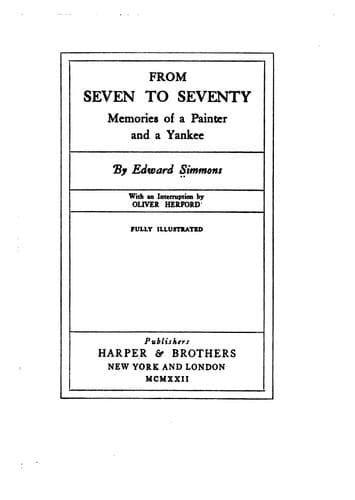
From Seven to Seventy: Memories of a Painter and a YankeeSimmons, Edward
General
From Seven to Seventy: Memories of a Painter and a Yankee
Simmons, Edward
Artists -- Biography
Delmonico’s was on Twenty-sixth Street. It was one of those landmarks
that always kept pace with the trend of the times. I can remember only
one very distinctive restaurant at that time; it was named the Au Petit
Vefour and was run by Henri, who used to cook for the Stomach Club in
Washington Square. Like all French places, it was not particularly
smart, but the table and service were always immaculate. Henri went down
to the markets every morning at six o’clock, digging down to the bottom
of the boxes of fruit and vegetables, and feeling of the chickens until
he managed to bring home the raw material which he and madame between
them prepared in a style fit for a king. Calories, vitamines, etc., had
not become popular, and I do not believe Henri ever heard of them, but
he could serve, by instinct, a balanced ration accompanied by the proper
wine. When you got through, however, it cost as much as Delmonico’s.
It is hard to picture New York without subways, and to think of the
tired workingman reaching his home after a hard day’s work by the aid of
a lumbering horse car. It seems almost incredible that so many changes
have taken place in thirty years. The horses of the Fifth Avenue buses
were the butt of many a joke in _Life_. One crossed by ferry to
Brooklyn, and the city was just beginning to dig the trench on Broadway
for the cable car, announcing with a loud voice that it was the first
cable in America. It did no good to tell them that I rode on one in San
Francisco in the ’seventies.
Of course, there were no traffic laws, as these are quite recent, and
this made the streets seem more crowded than they are to-day and
therefore harder to cross. There were one or two policemen at the most
prominent corners, but these seemed to have been chosen for their great
physical beauty rather than to aid traffic; vehicles could go right,
left, or backward if they desired.
The Tenderloin (which word originated from the remark of a police
captain that he would take it as his beat—“the best part of the animal”
from the point of view of graft) was in one section. Due to some
misdirected effort it is now scattered over the city. The days of
Chicago May are gone—she with golden hair, pale-blue eyes, looking
fourteen, but really twenty-five—dear, pathetic creature for whom
everyone was sorry. No longer does she beg the unsuspecting clubman to
“take her home and let her warm herself for a while by his fire,” only
to bawl him out in the vilest language if he did not recognize her when,
dressed in his “long and high,” he dallied up Fifth Avenue, making
Sunday calls. These days are gone, yes, but is it any better, I wonder,
to have a gambling den, a blind pig, or a house of prostitution tucked
safely away behind the portals of one’s most respectable apartment
house?
Public-domain text, read in full here on John Shaqi.
Reviews
Reviews
No reviews yet
Be the first to share your thoughts on this work.
Elsewhere in the archive
Join the Discussion
Join the discussion
Sign in to leave a comment or review.
Sign InorCreate an account