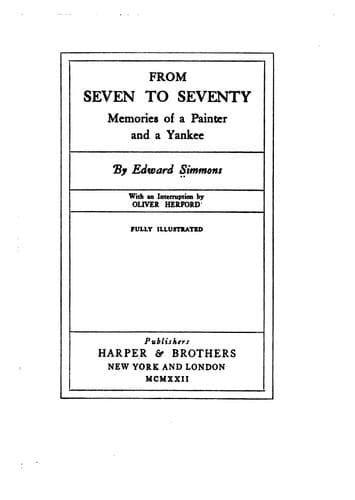
From Seven to Seventy: Memories of a Painter and a YankeeSimmons, Edward
General
From Seven to Seventy: Memories of a Painter and a Yankee
Simmons, Edward
Artists -- Biography
At the next meeting Frank arose and demanded the money he had saved the
committee, saying that he would bring eight of the foremost painters of
America to the fair and have them decorate the domes of the
Manufacturers’ Building. And so came the change from Italian workmen,
who had formerly smeared the walls with bad copies of their old masters,
to American artists (not experts in mural work, it is true, but full of
enthusiasm and fresh, original ideas). I was on the point of starting
back to Europe after doing a stained-glass window for my class in
Harvard, when I received a hurried call, and in spite of the fact that
Mr. George B. Post, the architect, upon being asked which of the Chicago
decorations he liked best, said, “Simmons’s—for if my building will hold
that up, it will hold up anything,” I feel that my career as a painter
was entirely changed at Chicago.
Olmstead originated the plan of the fair grounds—that charming idea of
letting in the waters of the lake to form canals instead of streets and
making a modern Venice. In the moonlight it was a veritable fairyland.
But the guiding hand in all things was Daniel Burnham, the
director-general. This able, handsome, and dignified man, always
undeniably a male, was as representative an American of the period as
one could imagine. He was large, of the Grover Cleveland type, but with
unbounded energy, one who worked while he worked and played when he
played. He could accomplish more in a day than any ten men, and one
reason was that he began early. Much to the consternation of some of the
directors, he used to call the meetings at seven o’clock in the morning,
and there was a great row if everyone was not there. These directors
were not an easy group to handle, and the presiding genius was often in
need of a high hand to keep them straight. For example, one of them,
much puffed up by his position and thinking to give it a fitting
setting, bought an old-fashioned tallyho and four, with all the
appurtenances, and came to the meetings (the great horn announcing his
approach) but—riding _inside_ his coach!
Cockroach Ranch—called so because they indulged in the best North
American manner of spoiling food—was the dining and meeting place of the
artists of the Exposition. Here, in a big, bare room, looking like a
railway station, with a long table in the center presided over by Elihu
Vedder as our _doyen_, we met and talked of all manner of things, while
such people as actresses and diplomats on a visit would sneak in to
listen to our extravagant conversation. In fact, we bragged so much at
night about our work and then at lunch the next day admitted it was
rotten, having seen it in the “cold, gray dawn of the morning after,”
that Bauer, the sculptor, said to us one day:
“You fellows remint me of a painter-man I used to know in Chermany. He
vas joost like you. He vould paint anythings, nothings—for money. One
day a fellow, he comes and says:
“‘Vill you paint me somethings?’
Public-domain text, read in full here on John Shaqi.
Reviews
Reviews
No reviews yet
Be the first to share your thoughts on this work.
Elsewhere in the archive
Join the Discussion
Join the discussion
Sign in to leave a comment or review.
Sign InorCreate an account