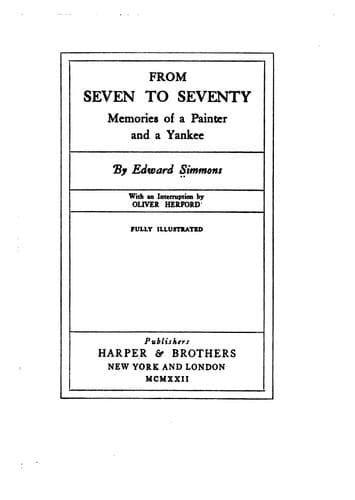
From Seven to Seventy: Memories of a Painter and a YankeeSimmons, Edward
General
From Seven to Seventy: Memories of a Painter and a Yankee
Simmons, Edward
Artists -- Biography
William A. Coffin originated a plan for the improvement of New York
which was said by prominent architects to be practical and paying, but
could not be carried through in a democratic country—there are many
arguments in favor of dictatorship. The human race will not economize
for its grandchildren unless forced to, and it will seldom vote “yes”
for a project that will not benefit the present generation. To fill in
the East River from Brooklyn Bridge to Fiftieth Street was the idea, and
so broaden the land and make a space to spread. The Fall River Line
would have to unload farther North, but there is no particular reason
why the shipping should concentrate itself at the Battery. Another
argument against it was that the good health of New York was due to the
fact that it was surrounded by water. This may be true, but it does not
seem to me that the East River carries away any refuse. The development
of the airplane will most likely make this unnecessary, however, as
mankind will take to the hills and the valleys will cease to have value.
New York is always symbolized for me by the steam that rises from the
housetops and looks so much like the plume of Henry of Navarre. It is
not black and dirty as is the smoke of so many European cities, but
diaphanous and variable, like the Latin races of which one element of
the population is composed. However, it is always and steadfastly
anchored to as solid a foundation as ever existed—that of the
English-speaking peoples.
I had hardly had time to renew my acquaintance with the greatest
metropolis of my country when I was called away to another large city.
To Chicago must be given the credit for the first public mural
decorations in America, and with her, Frank Millet (in whose brain was
born the original idea), backed by that most unusual genius—Daniel
Burnham. Millet was the director of fine arts for the Exposition of
1892, and one day, after a meeting, the whole committee went over to the
Manufacturers’ Building, where he was asked what color he wished to have
the ironwork painted. He wanted to know what the matter was with the
present color—it was that reddish gray, or crushed strawberry, the color
of iron as it comes from the foundry.
“Do you, as color man, stand for it as it is?” said Burnham.
He said he did.
“Well, you have saved us twenty thousand dollars.”
Public-domain text, read in full here on John Shaqi.
Reviews
Reviews
No reviews yet
Be the first to share your thoughts on this work.
Elsewhere in the archive
Join the Discussion
Join the discussion
Sign in to leave a comment or review.
Sign InorCreate an account