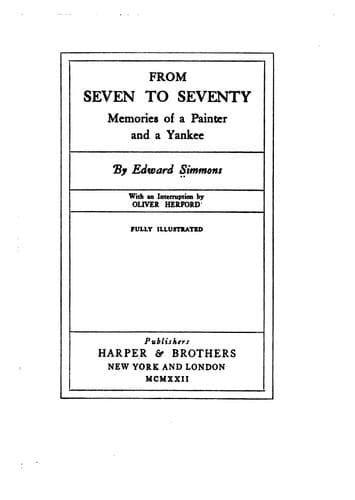
From Seven to Seventy: Memories of a Painter and a YankeeSimmons, Edward
General
From Seven to Seventy: Memories of a Painter and a Yankee
Simmons, Edward
Artists -- Biography
Once I was directed by a spirit as to how to paint a portrait. It was
out in the Middle West. Not quite so bad as the woman in London who used
to have interviews with one of her children born dead. In this case it
was the ouija board that operated every night and gave me my
instructions for the next day as to how to get the right expression upon
the face of this elderly woman who was sitting to me. A brother, born
four years before herself, had died at the age of five, and in that
other life, “over there,” he had kept in touch with the march of events
down here. When his sister journeyed, he journeyed with her,
miraculously learning the language of each country in which she happened
to stop, so that he could send her messages with a foreign flavor. He
told her what to do when she was ill and how to meet every problem of
life, but with all this vast knowledge he could not, or did not, tell
her how to keep young; and I had just as hard a time disguising the
wrinkles on her cheek and the cords in her neck as if she had been an
ordinary human being with no little brother guiding her from another
world. I could not but think—what a dull heaven to live in—so
irrevocably tied to this earth. This spirit was at the beck and call of
his sister, doomed to follow her every thought and action, with far less
freedom than if he had remained a poor mortal. I would rather sit on a
cloud with a ready-made halo about my head, and at least have time for
contemplation.
Now that I am on the subject of women—I do not mean to criticize harshly
(I have loved them all my life), but one thought leads to another. There
is the case of Mrs. McAllister. Of course, that was not her name, but it
will do as well as any other. Virgil Williams and myself were once
invited to her house in San Francisco to see a statue she had made. We
were told beforehand that this woman was one of the few beings who
disproved the theory that starving in a garret was necessary to be a
success in the fine arts. The death of her husband left her enormously
wealthy, and she decided to show her talents. First she wrote a best
seller; then she composed a concerto; then she painted and finally,
probably holding the belief that all the arts are interrelated, she
tried her hand at sculpture. This, a statue of Eve, was the object we
were asked to view. Williams, after looking at it awhile, said:
“Happily, Mrs. McAllister, we have both been married, and so I can speak
most freely. You have evidently forgotten one thing which is more
important than you think. You have neglected to put in the navel.”
“Oh, not forgetfulness, Mr. Williams,” cried this ultramodern woman
(psychoanalysis and sex discussion were not so free as they are to-day).
“In consulting with my spiritual adviser, the Reverend Mr. McCann, we
decided that as Eve was not born of woman, a navel was unnecessary.”
Public-domain text, read in full here on John Shaqi.
Reviews
Reviews
No reviews yet
Be the first to share your thoughts on this work.
Elsewhere in the archive
Join the Discussion
Join the discussion
Sign in to leave a comment or review.
Sign InorCreate an account