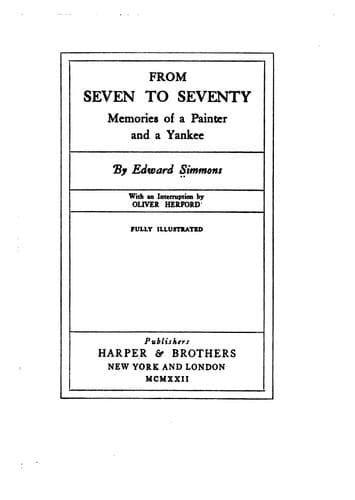
From Seven to Seventy: Memories of a Painter and a YankeeSimmons, Edward
General
From Seven to Seventy: Memories of a Painter and a Yankee
Simmons, Edward
Artists -- Biography
It has always delighted me to see William Hunt’s hesitation about that
sort of thing in his fine work for the Capitol at Albany. If he did
really put breasts and a navel on the figure at the stern of the boat,
they, like the decorations by the magician painter of the story, are not
to be seen by vulgar eyes. Oh, those inhibitions of Boston! As my uncle
George used to say, “Edward, anything but the physical or the material.”
I was too young then to realize that in talking so much about it he
proved his taste for it. But I am unkind; blind men should not be called
to account for the spots on their clothing.
Women are generally utterly ruthless where their vanity is
concerned—equal suffrage is doing away with this, however—and will
sacrifice the poor artist to its desires. The Ten American Painters were
having a retrospective show in Philadelphia. Naturally, we were trying
to get hold of all our good work, so I asked a society woman who owned
one of my best paintings to lend it for exhibition purposes. She replied
that she was having a tea that week and it would make a spot on her wall
to take it down. This was quite a contrast to Andrew Carnegie, who not
only gladly lent me a marine he had purchased some years before, but had
his agent box it, insure it, and send it all at his own expense.
Portrait painters have the hardest time, though, as every woman wishes
to see herself idealized or as she was twenty years before. Poor
Meissonier was asked to paint in Paris, a portrait of the wife of an
American millionaire well known for having made his money in the
gold-strike days of California. I knew the lady and I saw the portrait.
It was admirable in the sense of being a perfect likeness and bringing
out all of her limitations. She looked like a cook and he painted her
like a cook. She refused to pay for the work, saying that it was utterly
worthless; consequently, Meissonier took her into the courts. In France,
the artist has a better show than here, and he won. The lady paid the
bill, but announced that as soon as she got home she intended to burn
the portrait. Whereupon Meissonier’s counsel asked that the court forbid
this, as such an act would establish a bad precedent. It would lie
within the power of a wealthy man, wishing to revenge himself, to buy up
all the work of a client more than seventy years old, and, by destroying
it, render the artist’s life a vain and useless thing. The court took
his view and forbade the lady in question to injure the portrait. In
spite of the fact that she declared she would disobey, I saw the
portrait twenty years after.
Public-domain text, read in full here on John Shaqi.
Reviews
Reviews
No reviews yet
Be the first to share your thoughts on this work.
Elsewhere in the archive
Join the Discussion
Join the discussion
Sign in to leave a comment or review.
Sign InorCreate an account