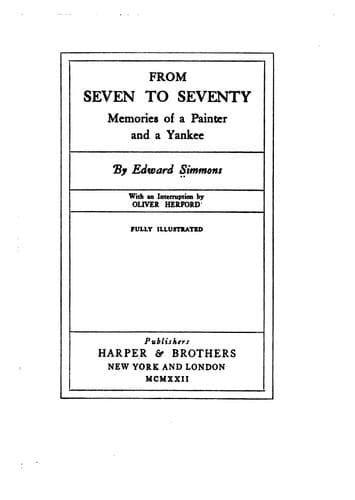
From Seven to Seventy: Memories of a Painter and a YankeeSimmons, Edward
General
From Seven to Seventy: Memories of a Painter and a Yankee
Simmons, Edward
Artists -- Biography
When the fine arts and literature meet, many interesting things happen.
We have our critics. Some of them are wise and some of them are dull,
but not many of them have the slyness of Mr. Emerson when he answered
Daniel French’s question as to what he thought of the bust the sculptor
had just finished of him, “That is the face I shave.” A queer thing—the
literary mind. I objected once to Gilder because he was criticizing a
picture, saying that it was not fair, as he was not a painter. He
replied that he had heard me discuss a sonnet.
“Yes,” I maintained, “but I have used the English language since my
earliest years. I am therefore a professional. You are not a painter.
You may say that you do not like a picture, but you may not say what is
the matter with it, as you did.”
Every time I think of Gilder I recall something he once told me about
the dead Lincoln. He had gone to view the body and was one of a long
line of people passing about the form as it lay on its bier, and was
much impressed by the august and noble smile on the dead President’s
face. So much was he affected by it that he turned to a man standing
beside him and mentioned it.
“Yes,” the man replied, “We rather flatter ourselves on our smiles.” It
was the undertaker.
It was surprising to see, after that, a sonnet by Gilder on Lincoln’s
smile. Sometimes an editor’s sense of humor becomes a trifle dulled. I
sat and heard a number of them discuss perfectly seriously whether the
word “hell” should be allowed in its entirety, printed “h—l,” or cut out
altogether.
I was once foolish enough to contract to make some covers for a
well-known magazine. All went well as long as I was allowed to choose my
own subjects, but when the editor got the brilliant idea of taking
characters out of the Bible and drawing them as modern men, I struck.
Take David, for instance; what financier would care to be represented in
such fashion? If the gentleman were alive to-day he would be in jail.
The editor threw up his hands and said, “But he is in the Bible.” Of
course it ended by my displeasing him.
I was called up on the telephone one day by Mr. J——, editor of one of
our yellow publications. He said his magazine was considering an article
on Decoration and told me to forward, without delay, permission to
publish a reproduction of my “Justice,” upon which there is a copyright.
I asked what there was in it for me. He was astonished that I did not
realize the enormous advertisement it would mean for me. I answered that
as _Harper’s_, _Scribner’s_, _Century_, etc. (at that time) always sent
me a check for seventy-five dollars when they reproduced anything of
mine, I though a thousand would just about pay me for dropping to the
level of his magazine.
Public-domain text, read in full here on John Shaqi.
Reviews
Reviews
No reviews yet
Be the first to share your thoughts on this work.
Elsewhere in the archive
Join the Discussion
Join the discussion
Sign in to leave a comment or review.
Sign InorCreate an account