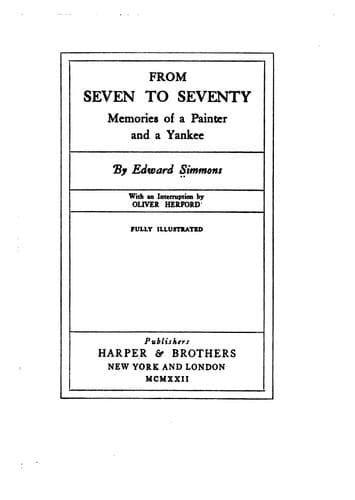
From Seven to Seventy: Memories of a Painter and a YankeeSimmons, Edward
General
From Seven to Seventy: Memories of a Painter and a Yankee
Simmons, Edward
Artists -- Biography
I was brought up as a young duke—without the estates!—and I was never
allowed to earn money. I recall being severely reprimanded by my mother
and made to walk back three miles to return a nickel a man had given me
for running an errand. I was told I should have been glad to do it for
nothing. I remember my surprise, years later, when I was in Europe, to
hear that Americans were “commercial.” The desire for great material
gain was either astonishingly developed in one generation, or did it, as
I suspect, creep in a little as the emigration from the Old World
increased? Certainly there was none of it in that truly American town of
Concord, Massachusetts.
[Illustration:
EDWARD SIMMONS
At the age of seven
]
In Concord it was no disgrace to be poor—nearly everyone was—and until I
was nearly grown I never had a new suit of clothes. My brother’s and my
breeches were made from the old army uniforms, the cloth having a
wearing quality that was almost like iron and would pull a nail out of
anything rather than tear. We were called “Blue Legs” until we were
quite grown up.
My cousins, the Emersons, represented affluence, in my childish mind.
Their house was a square wooden one, set among trees, mostly pines and
chestnuts. There was a solemn, gravelike quality to it. I remember going
down alone on errands, and always had a feeling of awe upon approaching
it. I think this was because the trees were so close to the house that
the grass would not grow and everything was damp around it. The door was
always open, and Mr. Emerson generally came into the hall when anyone
approached. This was a wonderful relief to me, as I was terrified by the
women and servants. The inside gave me the impression of wealth and
spaciousness. It may have been the reflection of the talk I heard at
home, but it seemed very impressive and august.
No amount of grown-up talk could make me fear Mr. Emerson, however, or
feel the slightest embarrassment in his presence. He seemed, like my
grandmother, to be a perfect example of serenity. He received me as an
equal and entertained me as if I were a young prince. He had reached
that extreme height of simplicity where he could be interesting to a
boy, and, while I preferred him to any of the others, I was quite sure
he did not count for as much.
Mr. Emerson’s study was to the right of the hall. There was a large
fireplace, and what were to me magnificent red-velvet chairs on either
side. There must have been hangings of the same material, as I got the
feeling of crimson everywhere. From the floor to the ceiling, the walls
were lined with books—books that had been read and reread until the
bindings were very much worn.
Of my early memories of Mr. Emerson, two are most vivid. The first in
his garden, where he often took me, walking slowly about and telling me
of each flower and plant as if it were a particular friend. I never read
his _Days_ that I do not visualize him in his “pleached garden,” showing
me his pear trees.
Public-domain text, read in full here on John Shaqi.
Reviews
Reviews
No reviews yet
Be the first to share your thoughts on this work.
Join the Discussion
Join the discussion
Sign in to leave a comment or review.
Sign InorCreate an account