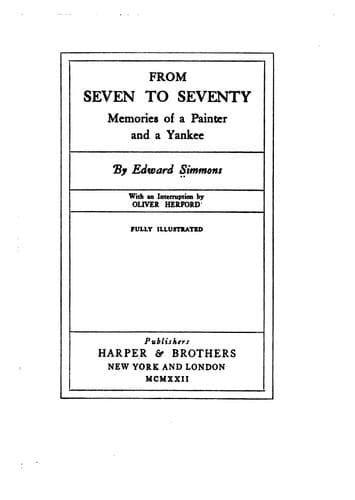
From Seven to Seventy: Memories of a Painter and a YankeeSimmons, Edward
General
From Seven to Seventy: Memories of a Painter and a Yankee
Simmons, Edward
Artists -- Biography
If I had the task of taking to Europe one thing as the best work of art
of America, I should take the tomb from the Rock Creek Cemetery in
Washington, which was created by those three artists—Saint-Gaudens,
Stanford White, and Henry Adams. Nothing we have made in this country as
yet, whether paint, carving, or architecture, can equal it. This figure,
an expression of the idea of death, marks, I am told, the last resting
place of the wife of Henry Adams, but there is no name and no
commemoration to any individual, no signature of artist or architect; it
is universal and might belong to any one of us. A pilgrimage to this
monument of a man’s respect for the woman he loved is, of necessity, a
sacred rite. One cannot pass gayly by in a motor car and give a careless
nod of approbation, but one must alight (let us hope from one of those
old-fashioned rickety open barouches, driven by the last of the negro
coachmen) and proceed up the narrowest, most delightful little path,
overgrown with shrubs and bushes, where at the top of a knoll and
carefully concealed from common gaze is the Sphinx. Like the pilgrims to
the ancient shrines, one wishes one had courage to go back and approach
this beauty of all time and no time, upon one’s bended knees. And her
surroundings! How wonderfully the loving architect has framed her; no
word and no talk about death. There she sits and speaks to everyone, and
the message is the secret of his innermost thoughts—so much as he
brings, so much does she tell, and no more.
One day in Paris the _Figaro_ started a reporter out to get the opinions
of different intellectual men upon death. Some gave a column, some a
half column, but when it came to Alphonse Daudet, he said:
“My idea of death?—_la mort?_—_psutt!_—”
There is nothing to say, and all I can think of when looking at the Rock
Creek Memorial, are the words of Shakespeare,
The Rest is Silence
Chapter XII: Fine Arts in Relation to “A Number of Things”
It was during this period of my life that I did my best work; I had a
good studio in Carnegie Hall, freedom from money worries, and abounding
spirit. Also, my imagination was still fresh from the influence of
Europe, and the Old World was enough in retrospect for me to realize its
worth. One of the most interesting orders I received at this time was to
decorate a room in the new part of the Waldorf Hotel, that addition
called the Astoria. It was a long, narrow hall, the Astor Gallery, with
boxes all around a dais at one end. The room was an attempt at the
French of Louis Seize—bastard architecture, I think—fancy work and
rococo with curves and bends everywhere. After my work was all finished
I had to get up and paint over again the ribbon held by one of the
Cupids. It was taut and I changed it to wavy, as it proved to be the
only straight line in the whole room.
Public-domain text, read in full here on John Shaqi.
Reviews
Reviews
No reviews yet
Be the first to share your thoughts on this work.
Elsewhere in the archive
Join the Discussion
Join the discussion
Sign in to leave a comment or review.
Sign InorCreate an account