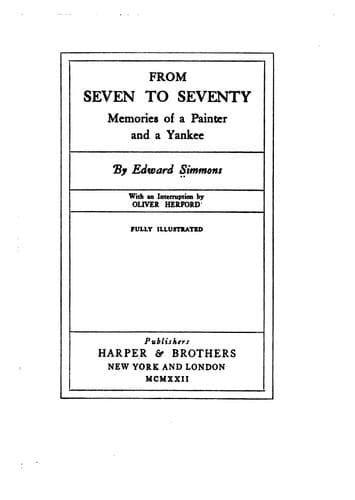
From Seven to Seventy: Memories of a Painter and a YankeeSimmons, Edward
General
From Seven to Seventy: Memories of a Painter and a Yankee
Simmons, Edward
Artists -- Biography
After I had submitted my sketches and they were accepted by the
architect, I had to go and sign my contract at the offices of John
Downey & Son. There was a large room full of stenographers and
bookkeepers, with a glass place on one side for the boss. John Downey
came out to greet me. As we sat at a big table, he pushed toward me a
long document, saying:
“There’s your contract. If you’ll read it over and it is satisfactory,
you’ve only to sign it and get your first payment.”
I read it and reached for the pen to sign. He must have seen some doubt
upon my face.
“Is it satisfactory,” he asked.
“No, but I’ll sign.”
“Why, I drew that contract myself! What’s the matter with it?”
“There is not enough time,” I replied.
His eyes narrowed.
“Mr. Simmons, you have lived a long time across the water? Yes? Let me
tell you something about American business methods. Never complain over
here that you haven’t enough time. If the job suits you, wade in and do
it. If you can’t finish it yourself, put on more men and work nights!”
“But there are things that can’t be done that way,” I insisted.
“Sir, I’ve been a contractor for twenty years in New York City and if
there is anything you cannot do that way, I should like to hear about
it.”
“Well,” I said, “I admit your business position, but I still believe
that if you wanted a son and heir you would have to respect the old rule
to wait nine months, and not put on more men and work nights.”
Sensation among the blond typewriters!
The working of a business man’s mind can never be guessed at beforehand.
I painted two decorations for one of America’s foremost financiers. In
making the sketches I was mindful of the fact that he was a pillar of an
orthodox denomination of the strictest type, and, while I suggested a
group of dancing figures, I was very careful to drape them sedately with
several layers of chiffon. What was my surprise when the criticism came:
“Mr. Simmons’s idea is very delightful, but the figures are not nude
enough!”
The late Andrew Carnegie was a good old-fashioned type of man who
thought the God-given power to amass a large fortune was indication of
an all-embracing good judgment and taste. I never met him but once. It
was in ’91, at a show of pictures of the Society of American Artists. I
was presented to this short, stout little man. “Mr. Carnegie” meant
nothing to me, as I had just come straight from England, and his fame
had not managed to penetrate the shores of Cornwall. He was most
indifferent, did not like the exhibition very much, and announced that
he has purchased the only good picture, pointing to an unimportant
landscape. Abbot Thayer’s “Madonna” (which Clarence King said should
have buckets under it to catch the dripping sentiment), a charming
Thomas Dewing, a beautiful thing by Theodore Robinson, and others were
all about him, so I ventured to tell the doughty Scotsman that he must
be deeply ignorant on the subject of art. That naturally closed the
interview.
Public-domain text, read in full here on John Shaqi.
Reviews
Reviews
No reviews yet
Be the first to share your thoughts on this work.
Elsewhere in the archive
Join the Discussion
Join the discussion
Sign in to leave a comment or review.
Sign InorCreate an account