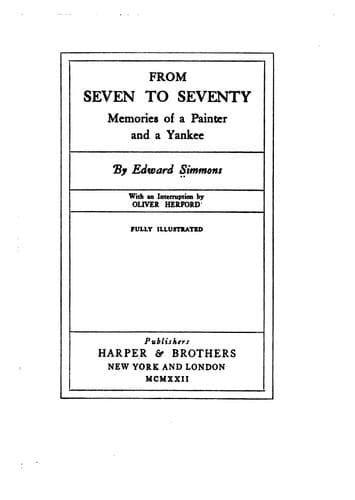
From Seven to Seventy: Memories of a Painter and a YankeeSimmons, Edward
General
From Seven to Seventy: Memories of a Painter and a Yankee
Simmons, Edward
Artists -- Biography
After the decorators had been chosen for the work in the Appellate
Court, the chief justice asked me to bring in some of my former
contracts that he might see the form and make one for us to sign more or
less like them. Then, later, he asked me to make one which I thought
would serve. As the question was then vitally at issue about the
copyright, I slipped in a small clause—“artist to retain the copyright.”
It came back to me blue-penciled, so I saw it would be no use. Later,
the chief justice gave a talk at a lunch to which I was invited, and
remarked that Mr. Simmons was “not only an able painter, but a keen
lawyer.” If it had not been for an accident, he would not have noticed a
certain line that I had put into my contract, and I would have obtained
a decision of the Appellate Court for nothing. That line would have
established a precedent for the state of New York, and from that time
all artists would have had and owned their copyrights.
James Lord was the architect of the Appellate Court. There was great
trouble because he signed out the triptych to three men when it should
have been given to one. He evidently wanted to give everyone a chance,
for in the other part of the building he gave one frieze to five men.
Our triptych was done by Blashfield, Walker, and myself. We were to do
Justice in three forms, and as the work of Blashfield and myself was
more nearly alike, we put Walker in the middle. I waited until
Blashfield had determined the composition, the color scheme, and even
until he had actually painted his background, and then, as far as I
could, I followed him. After the canvases were completed and on the
wall, I found that my two figures of small boys in the foreground were
not in the right place, so I painted them out and moved them up four
inches higher. Blashfield went even farther. He took out a woman’s
figure with her back turned and changed her completely, because he did
not think she agreed with the general composition of the three. These
changes were very difficult, as they were done under a different light,
in a different place from the original work, and, of necessity (as the
building was then in use), without the assistance of models.
A remark of Richard Canfield’s on my panel is worth quoting. I have, in
the foreground, a symbolism of a child pushing away the nose of a
vulpine animal with his right hand, to protect a rabbit at his left. The
great gambler said:
“By George! Simmons, I did not know you had so much intelligence as
that. That symbolism of yours is very apt: Crime, Ignorance, and
Stupidity. Is that what the Appellate Court stands for?”
Public-domain text, read in full here on John Shaqi.
Reviews
Reviews
No reviews yet
Be the first to share your thoughts on this work.
Elsewhere in the archive
Join the Discussion
Join the discussion
Sign in to leave a comment or review.
Sign InorCreate an account