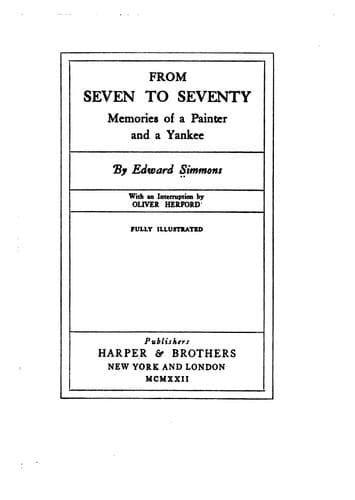
From Seven to Seventy: Memories of a Painter and a YankeeSimmons, Edward
General
From Seven to Seventy: Memories of a Painter and a Yankee
Simmons, Edward
Artists -- Biography
At my first interview with Canfield I got a taste of the man I was to
deal with. Clarence Luce was the architect who made the gambling house
on Forty-fourth Street, next to Delmonico’s, and he came to me with a
proposition to decorate it, saying that I was to talk the matter over
with Mr. Canfield himself. I, of course, decided he would know nothing
of art and it would be rather trying. I was mistaken. A short, fattish,
powerful man greeted me and said, only:
“I want your best work. You know what that is and I shall know it when I
see it. We’ll talk the money over later.”
This did not seem extraordinary to me at the time. Sad experience has
since taught me to do nothing without a contract, but I have always
found that with men of the character of Richard Canfield, nothing of the
sort is necessary. In working for John Dunston, proprietor of the famous
“Jack’s” Restaurant, I would paint a panel in my studio, take it down to
the room, and put it upon the wall, go directly to the office and get my
money—no criticism of my work and no arguments—just a man’s word, and as
to the artistic part of it, he considered my judgment better than his.
Like Napoleon, when Canfield wanted anything done, he employed the best
men and told them to go ahead. He became a great friend of Whistler’s
and has written one of the most interesting accounts of the painter that
I have read. Whistler painted Canfield’s portrait and doubtless found
him a congenial companion—as who would not? He knew life, he knew human
nature, he was an expert on guns and firearms and had killed his man or
I miss my guess; and yet I must say that Richard Canfield was a man in
every sense of the word and as much a gentleman as one who lives outside
the law can be. He was the god of all the smaller gamblers and had
helped more than one over the rough spots.
The house where fortunes were made and lost is standing to-day, and from
the outside resembles nothing more than the ordinary, narrow, three- or
four-story, brownstone dwelling place. In Canfield’s time, Clarence Luce
had managed to transform the interior until it was quite a gem in its
way. Entering by the big swing door, one stepped into a small vestibule
done in Numidian marble. In the ceiling were five rhomboidal panels of
thin jade behind which were lights casting a soft glow, Oriental in its
effect (one might imagine it to be Cleopatra’s bedroom), and giving a
thrill of mystery right at the start.
Public-domain text, read in full here on John Shaqi.
Reviews
Reviews
No reviews yet
Be the first to share your thoughts on this work.
Elsewhere in the archive
Join the Discussion
Join the discussion
Sign in to leave a comment or review.
Sign InorCreate an account