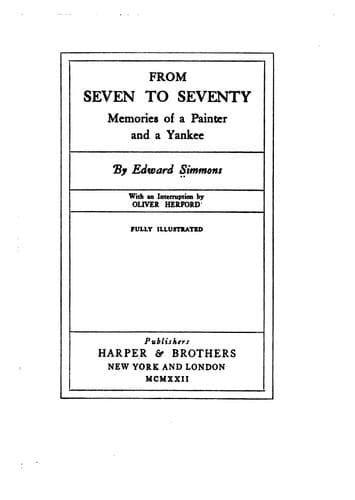
From Seven to Seventy: Memories of a Painter and a YankeeSimmons, Edward
General
From Seven to Seventy: Memories of a Painter and a Yankee
Simmons, Edward
Artists -- Biography
I do not believe the ordinary politician ever considers the fine arts
seriously. To him beauty is something for Sundays or holidays, and he
lets the women attend to it. At least, when we were in Washington some
years ago, making an attempt to have the tax on art removed, I had a
chance to judge the mental weight of one Congressman. I was asked to be
one of the party (as one of the minor speakers only), for I could tell
what I knew of the same matter in France and England. I was fool enough
to say, in the course of my argument:
“This may not go down with the woolly West, but it should in the East.”
Instantly a long young man, with a shock of dark hair falling over his
forehead, rose and said:
“What’s that, Mr. ——” (turning to his neighbor to ask my name)—“oh,
Simmons? What do you know about the West, if I may ask. How far west
have you ever been?”
I think he took it for granted that I was born (like Sargent) on the
other side. I answered:
“Three years under the shadow of Mount Shasta, Mr. Bryan.”
I knew William Jennings by sight and judged that he had not ventured so
far from his home town as I had. He was silenced by the chairman and
there was a chuckle.
Anders Zorn told me two stories about Grover Cleveland, showing the
extraordinary penetration and understanding of this statesman. While he
was doing a portrait of the President, at one time he took the canvas
and turned it upside down to look at it. To Cleveland’s questioning he
replied that he was doing it to see if he had painted the book too high
in value, adding:
“What do you think?”
“I suppose you painters use the word ‘value’ to mean the importance a
thing holds in its effect upon the eye of the beholder. Yes, I think it
is too high but why do you turn it upside down?”
Zorn was interested. “Why do _you_ think we do?”
“It must be to see it from a new point of view. To get a new conception
of it all.”
It was, but how keen of him to have thought it out!
Zorn asked Mrs. Cleveland what her husband’s friends thought of the
portrait. She replied that she did not know anyone who fitted that
description, that he had many acquaintances, but no one that she could
call his friend. It seems that the higher a man climbs, the farther
behind he leaves his associates. Shakespeare must have been very lonely
away up there on the mountain top.
Public-domain text, read in full here on John Shaqi.
Reviews
Reviews
No reviews yet
Be the first to share your thoughts on this work.
Elsewhere in the archive
Join the Discussion
Join the discussion
Sign in to leave a comment or review.
Sign InorCreate an account