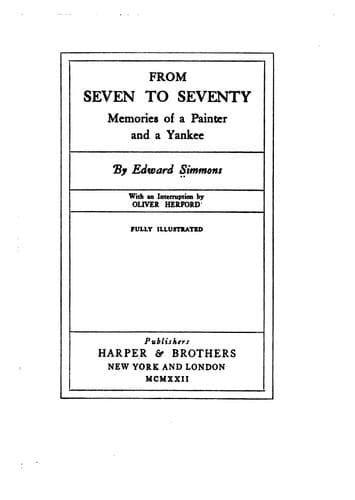
From Seven to Seventy: Memories of a Painter and a YankeeSimmons, Edward
General
From Seven to Seventy: Memories of a Painter and a Yankee
Simmons, Edward
Artists -- Biography
Sprang to his feet? Where must he have been? Lying behind something. I
had shot, fished, and traveled over this land all my life—it was only
just across the river from our house—and there was nothing there in my
boyhood behind which a man could have hidden. I looked this up and found
there had formerly been a wall so that the market women during the
spring freshet could walk dry shod in the days of the Concord River’s
overflow.
Considering the fact that I had never seen green grass anywhere near
Boston on the 19th of April, it may seem strange that I put it into my
decoration. Of course, I preferred it for my color scheme, but I
actually found a letter from a woman of the period and of that date,
saying, “I saw green grass waving out of my window this morning.” It
appears that that year they had an unusually early spring.
[Illustration:
“THE RETURN OF THE FLAGS”
Panel by Edward Simmons, Boston State House
_Copyright by Edward Simmons; from a Copley Print_
_Copyright by Curtis & Cameron, Publishers, Boston_
]
When I painted my second panel, I thought of the order that the Pope
gave to Raphael to paint him putting out a fire by the power of God. The
Pope naturally saw himself the principal figure and was disgusted when
he found that Raphael had made him a little figure on a balcony in the
distance, the artist preferring a group of maidens rushing around in the
foreground with jugs of water as being more interesting to paint. Now my
subject was War, and when I chose as my other panel “The Return of the
Battle Flags into the Custody of the State after the Civil War,” many
people naturally expected that the governor and officials would occupy
the prominent place on the canvas. The governor was an admirable man and
did a great deal toward winning the war, but in actual fact he was about
five feet high, “pot-gutted,” bald headed, and not an attractive object
from a painter’s point of view. I did not wish to do a group of
portraits, but a decoration, so I imagined myself in the park, looking
up at the State House, with a line of color sergeants marching up the
steps to present the flags to the governor and officials waiting above.
As they were two or three hundred feet away from the gate, I had to
reduce them to twelve or fifteen inches in height, thereby making
lifelong enemies of several who were still alive. When the G. A. R.
found I was not to do the officers, but the color sergeants, my trouble
was by no means over, for the wives and relatives of more than a dozen
sent me photographs of their beloved ones, some of whom were dead, some
of whom had lost an arm in the war. Many of the likenesses were of the
individual thirty years later than the day he carried the flag! _All_,
of course, expected to be represented in the decoration by a life-sized
portrait. I obviated this difficulty by making them march up the stairs
away from one, as they naturally would have done, and a back view is not
a good portrait.
Public-domain text, read in full here on John Shaqi.
Reviews
Reviews
No reviews yet
Be the first to share your thoughts on this work.
Elsewhere in the archive
Join the Discussion
Join the discussion
Sign in to leave a comment or review.
Sign InorCreate an account