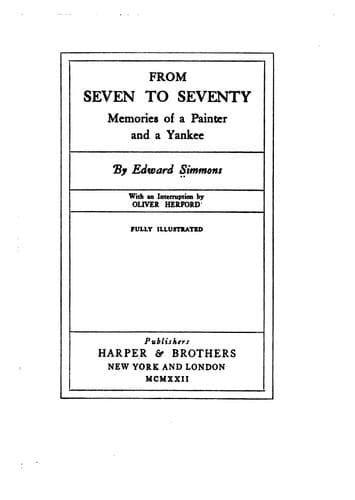
From Seven to Seventy: Memories of a Painter and a YankeeSimmons, Edward
General
From Seven to Seventy: Memories of a Painter and a Yankee
Simmons, Edward
Artists -- Biography
I never understood Boston—or, in fact, New England—until I went back
there after having spent years in Europe. There are many delightful
qualities about the Bostonese type of mind, but their comprehension of
the senses only through abstract matters limits their personal
enjoyments. However, we cannot quarrel with them on some scores. Their
love of music, for instance. I have heard music in three places in my
life in such a way as to approach the indulgences of the Mad King of
Württemberg. If one is not alone, one must have the sense of being
alone; there must be no rustling of programs and no talking. Therefore
the perfect way to listen to music is to have an audience composed of
one’s friends. You cannot tell a stranger to “shut up,” but you can a
friend; and you can also ignore him and thus establish solitude.
In the Vaudeville Club, in the studio of Augustus Saint-Gaudens, where
every year he used to give a Sunday concert in memory of his dear friend
Welles’s birthday (as a rule it was a stringed quartet); and in the St.
Botolph Club of Boston, I have really enjoyed music. We had the Kneisel
and the Adamovski Quartets—the most wonderful music I ever heard. The
man sitting next to me might have been anybody from a prince to
Paderewski. I learned more about music and fell more in love with it
than I had in all the remainder of my life because I got it under
congenial surroundings.
Paderewski I never knew well, but have had the pleasure of playing many
a game of pool with him. It was said that he ate nothing and drank only
water during the day, if he was to play at night, a habit I can
understand; for whenever I have had the problem of making what was to me
a great composition, I have found it necessary to train for it by
exhausting my nervous forces, thereby rendering myself simple in
thought. So I imagine him drawing himself fine. After a performance he
would arrive at the St. Botolph Club, wanting much food and, when he had
fed, much fun. “Now let’s play poker; now let’s play pool.” It was not
the game, it was the sociability he wanted; because, once in it, he
never knew when it was his turn to play, never could remember to ante,
and talked all the time.
Paderewski comes nearer to being the traditional genius than any other
modern—all the eccentricities with the real stuff underneath. They say
he kept, in his younger days, a pet poodle to supply the requests he
received for locks of his hair. And then the story of the cherry stones
which a woman found lying on the corner of his mantelpiece one day and
appropriated, and which she had set in a pin of clover-leaf pattern.
Upon her calling the artist’s attention to it, he remarked: “That is one
of the carelessnesses of my valet. It must have been he who left them
there. Personally, I loathe cherries.”
Public-domain text, read in full here on John Shaqi.
Reviews
Reviews
No reviews yet
Be the first to share your thoughts on this work.
Elsewhere in the archive
Join the Discussion
Join the discussion
Sign in to leave a comment or review.
Sign InorCreate an account