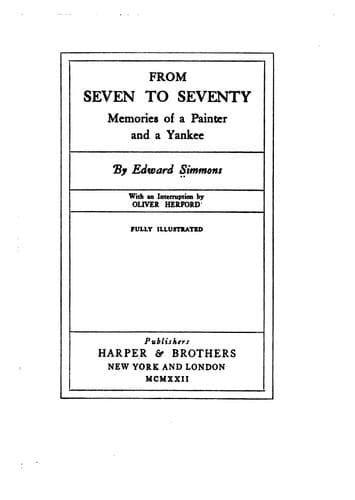
From Seven to Seventy: Memories of a Painter and a YankeeSimmons, Edward
General
From Seven to Seventy: Memories of a Painter and a Yankee
Simmons, Edward
Artists -- Biography
One of the drawbacks of Bostonians is the lack of a true sense of humor.
The assistant professor of mathematics at the Technological School once
told me that he comprehended infinity. A large order, but he was
perfectly serious. While they are willing to claim such an advance in
one direction, they sometimes seem to have no realization of the advance
of the civilization of this earth. One of the younger members of my
family—upon moving to Richmond, Virginia, two or three years ago—was
admonished by an elderly spinster of Boston to “be sure and be kind to
those poor heathens in the South.” She meant the negroes!”
Boston is a city apart. It has nothing to do with the rest of the
country. Twenty years ago my mother, like all good Bostonians, stopping
at the Murray Hill Hotel here in New York, said:
“Only think, Edward, there are thirty Cabots sailing to-day on the same
steamer.”
She was much shocked when I remarked, “I hope it is a strong ship.”
Dr. Samuel Cabot’s house was always a revelation to me. It was full of
stuffed birds in glass cases. He was not without a sense of the
ridiculous, however, for when he was persuaded to go to see a picture by
his brother Edward (whom all the women worshiped for his artistic
tendencies), he said about this painting—entitled “Peace”—of two birds
building their nest in the mouth of a cannon:
“That’s just like Edward; both his birds are male.”
This desire of ignoring sex was paramount in many learned and otherwise
delightful folk. I remember William Ware and had great respect for him,
but I had to laugh at him. He was an architect of ability and a
professor at Columbia, loved by his pupils, but the kind of man who had
no respect for any idea that was not fifty years old—so that it was
certain to be absolutely true before he taught it. He told me once that
he had never been able to see any reason for women’s existence. It must
have been this side of his nature which caused him to go about with a
small hammer and eliminate all evidences of sex from the newly arrived
Greek masterpieces for the Boston Art Museum. He could not see anything
incongruous in the fact that the fig leaves (cast by the workman in the
Museum) were of a different color from the statues. Strange type of
mind—and yet he had cleverness and a certain wit. My aunt had asked her
husband to invite Professor Ware to dinner, but, thinking my uncle might
forget the message, wrote a letter in addition. The professor answered
both. The letters are records of brevity.
Dear Sophy: Yours with pleasure, W. W.
Dear James: Yours as to your wife, W. W.
Chapter XIII: The Players
Public-domain text, read in full here on John Shaqi.
Reviews
Reviews
No reviews yet
Be the first to share your thoughts on this work.
Elsewhere in the archive
Join the Discussion
Join the discussion
Sign in to leave a comment or review.
Sign InorCreate an account